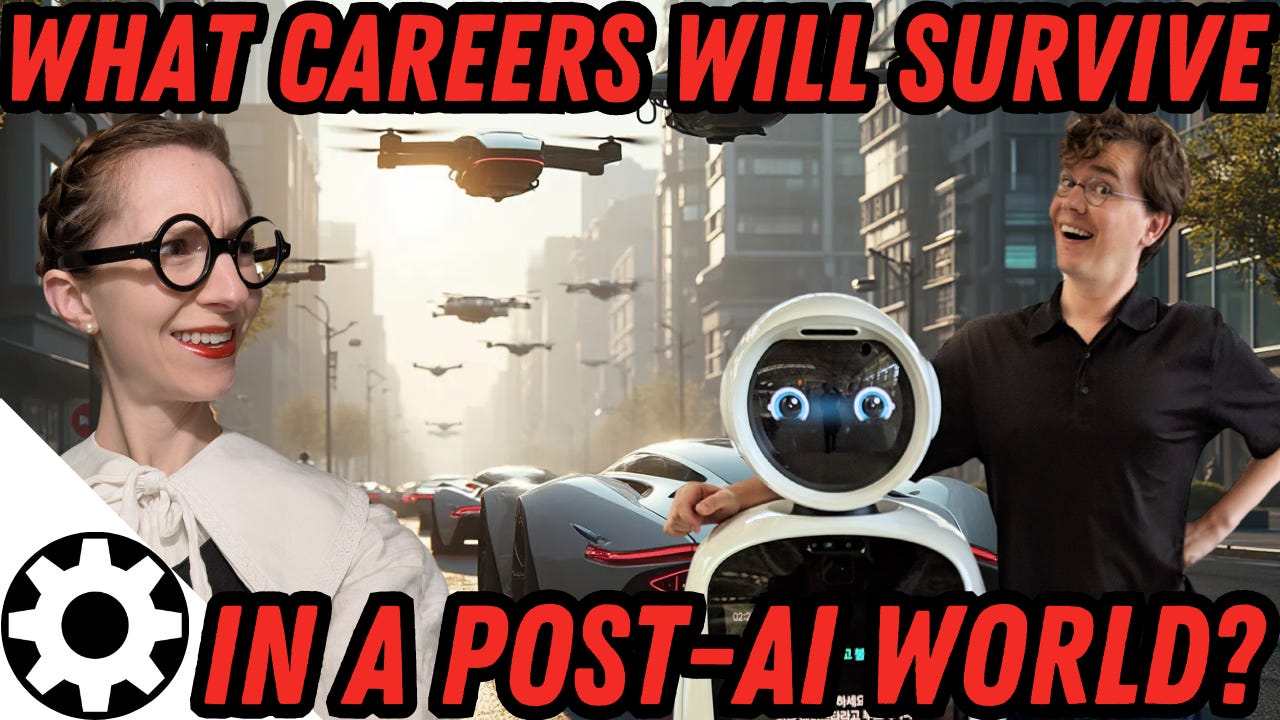
AI Killed Job Security: How to Survive in a Post-AI Workforce
Join Malcolm and Simone as they discuss the shifting landscape of the job market and how we need to adapt both our professional lives and parenting strategies to a future dominated by AI and automation. They explore the historical context of traditional jobs, the rise of gig work, and the proliferation of AI, and reflect on practical steps to prepare the next generation, including fostering AI literacy, hands-on skills, and strong personal networks. The conversation also touches on the implications of Universal Basic Income and the need for children to build unique, high-value skills in a rapidly changing economic environment.
Our solutions:
- https://parrhesia.io/student-signup
- https://wizling.ai/
Hello, Simone. I'm excited to be here with you today. Today, we are going to be discussing the fact that if you are young, Today, or you are raising kids today, you need to be raising them for a post job economy.
Yeah.
Making very different decisions about the way that you help them prep for, well, being financially stable as an adult. And it also means in terms of your own decisions. I think for a lot of us, we will be in a post job world. What do you think? 25 years?
Yeah, well, the future is here. It's just not evenly distributed.
I think there are many people now who are losing their jobs and we'll never get one again, period. Mm
hmm. And here when I say job, I mean traditional nine to five, like recurring revenue. That is, and Simone, do you want to go into like what is causing the end of the concept of a job? And I first note here for a lot of people who think that this is like an insane thing, jobs are a fairly recent invention.
They were really only invented as like a math thing in like the 1920s.
And this concept of having a lifelong job and getting a gold watch and having a pension that I, it was such a short lived phenomenon. It's hard for me to imagine that, like, how did we ever get that impression that it was going to be that way forever?
Yeah. Go into this.
Yeah. So I think already for a long period of time, we've seen a very slow easing into this and it hasn't just been about AI. And I think that also the way that job reports are coming in there's a lot of under reporting because obviously they're not reporting people who stopped looking for a job entirely and the number of people who are living now by gig work and piecing together a lot of jobs, including short term jobs, is just so high now.
I don't, and I count those as jobs and I don't think most people count them as like long term jobs either because they're not sustainable, they get laid off all the time or they change jobs all the time. So I want
to elevate something you said here because I think that a lot of people might miss this.
And it's what was the economic pressure that led to the concept of a nine to five job that stopped existing long before AI? The reason why you had quote unquote jobs and the skyscrapers that house these people back in the day, it was largely due to the difficulty of long distance communication.
So,
If I was a company and I wanted somebody who was. at X task. Okay. And I wanted to be sure I had somebody who is competent at X task this year and I had somebody who is competent at X task in 10 years or five years or next year. The most cost efficient way to get one of those people was to source.
A competent sort of blank slate and train them in that task. Maybe somebody who had a bit of training in that task to begin with. And so the way I would do this is I would go to the most elite universities or the universities in my area as sort of an authentication mechanism. I would find individuals who are graduating.
And I would say, okay how well, you know, how well are you? Like, how smart are you generally? And I can get that from their GPA. And then I would hire them. And then I would train them up as much as I could for a specific task. And you saw a lot of like rotation programs start for this, for like management jobs, you saw a lot of, but, but that was the idea.
It was, it was not that these companies cared about people. It was that it was efficient and this is why you had to go.
More than that, it was worth it for them to invest in training, which is another clear sign to, I think, many people intuitively already that permanent jobs and stable jobs are gone forever.
No one trains anyone anymore. This idea of like apprenticeship and investing in someone's training is just non existent. People expect you to come out of the box completely ready to go on day one with absolutely zero support. This isn't
totally true. Slow moving organizations, rotational programs still exist and stuff like that, but they're being phased out.
They're totally being phased out. And I feel like they, they didn't really, they didn't have high efficacy. So,
so this worked because if you were trained in this stuff and you were in most cities, there really wasn't that much mobility you had, you know, you might be able to go work for one other competitor or something like that.
But there was a huge reason to stay with the company you were with because of that, but also because of like the pensions and the benefits and stuff like that. They worked into their systems that a lot of the benefits for working in for them required working for them a long time. So they were aligning the interests here.
They invest in you, you invest in them.
And it was worth it for this company to invest in this person because they could reasonably expect this person to stick around. For the duration of their career. Otherwise it doesn't make any sense to train someone, which again, like it's, it's not the company's fault, by the way, that they're not training people.
People are so flaky. Like it is, it is an active risk to even think about training someone.
And it wasn't AI. This is where you have the charts and you can watch our video on this or we go into this a lot more details what actually happened in, I think it was 1976 where you see all the charts begin to diverge in terms of like income data and everything like that and salary rise and everything.
And what it was, was that was the big rise of outsourcing that started. So phones became common and internet became common were the two things that happened. Yeah. And that meant that if I am a company and I want somebody who is skilled. In, let's say, accounting, okay and I want to, as all companies intrinsically do, pay the least I can to get somebody who is broadly competent in this, given that living standards in Africa or India or the Philippines are dramatically less than they are in the United States I can hire somebody who might do a slightly worse job, might have slightly fewer like connections in the office or be able to connect with people, but I'm paying one 10th when I'm paying somebody in the U S why would I pay somebody in the U S when I can pay one 10th of what I'm paying in the U S?
Yeah.
Yeah. And this is what led to the collapse of global poverty. This wasn't all bad. If you look at poverty rates worldwide, they begin to collapse like severe poverty rates at the same time as U. S. salary begins to stagnate.
And this happened for a long, long time. This was happening for, but there were still roles that made sense.
There was still bureaucratic inertia within the United States. And, and some other countries in the developed world. AI changes that entirely.
Yeah. Well, I think first there's, there's a couple of things that happened and before even AI started happening, just general tech and automation have been progressively changing this over time.
It's not like there's a before AI and there's an after AI period. There's a before email and after email. There's a before like all these different type
You May Also Like

The Latest with Loren LoRosa
The Black Effect Podcast Network and iHeartPodcasts

Daily Inspiration: The Steve Harvey Morning Show
Peter Mutua

RADIO KULTURAEUROPA
RADIO KULTURAEUROPA

How Men Think
iHeartPodcasts

During the Break with Clint Powell
Clint Powell

Keeping It Real: Conversations with Jillian Michaels
Jillian Michaels

Coach Corey Wayne
Coach Corey Wayne

CAMINANDO POR EL MEDIO
Radio Trend Topic

Am I the Jerk?
youtube.com/amithejerk

Es Noticia
esRadio
The Latest with Loren LoRosa
The Black Effect Podcast Network and iHeartPodcasts
Daily Inspiration: The Steve Harvey Morning Show
Peter Mutua
RADIO KULTURAEUROPA
RADIO KULTURAEUROPA
How Men Think
iHeartPodcasts
During the Break with Clint Powell
Clint Powell
Keeping It Real: Conversations with Jillian Michaels
Jillian Michaels
Coach Corey Wayne
Coach Corey Wayne
CAMINANDO POR EL MEDIO
Radio Trend Topic
Am I the Jerk?
youtube.com/amithejerk
Es Noticia
esRadio
Community discussion