Are Male Witches Just Scientists? (Witches Vs. Logic)
Roast some marshmallows alongside us at the very-non-mystical Based Camp fire pit as we question whether the occult has become overly feminized and explore what masculine mysticism actually looks like. Our discussion examines historical figures often labeled as wizards, tracks word usage over centuries, and contrasts failed esoteric paths with the development of real science. We also ask the inevitable question: Why did competent men historically move away from ritual and toward empirical methods?Our conversation covers arguments from a recent YouTube video on the topic (Broken Ruune’s argument that The Occult Has Become Too Feminine), reviews key Renaissance and modern practitioners, and explains why mysticism lacks feedback loops that drive progress. It also touches on why AI and technology now fulfill the creative and constructive impulses once channeled into the occult.Expect analysis of data trends, institutional legacies like Waldorf education and biodynamic farming, and a clear conclusion on why serious inquiry leads to science rather than spells.
Show Notes
Hat tip to Broken Ruune for The Occult Has Become Too Feminine”
Did We Actually Lose Male Mystics?
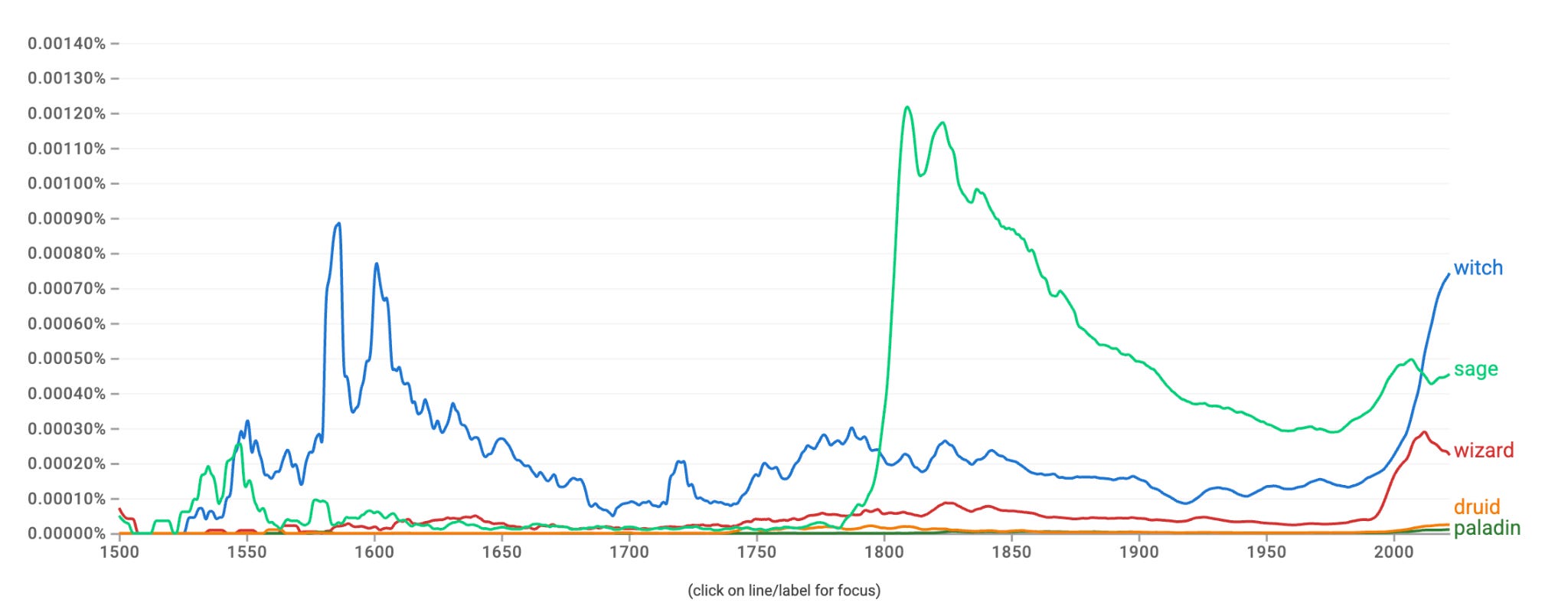
Trends & NGram Viewer
Comparing: witch, wizard, paladin, druid, sage
Hate to break it to Broken Ruune, but witches have been dominating since at least the middle ages per Google NGram Viewer at least
Unexpectedly, it’s closer on Google Trends, wizards aren’t that much worse off than witches (maybe because of Harry Potter though).
Malleus Maleficarum
In Malleus Maleficarum, is the focus on only female witches? What about wizards, paladins, druids, and sages? Are they also called out as a threat in the book?
ANSWER:
* The Malleus Maleficarum overwhelmingly focuses on women, but it does not say that only women can practice witchcraft.
* Its author, Heinrich Kramer, argues that women are more likely than men to be witches; the book also discusses male practitioners and condemns sorcery and divination.
Historical Wizards
John Dee (1527–1608/09)
* English mathematician and adviser to Elizabeth I who practiced alchemy and astrology, and undertook ritual attempts to communicate with angels through scrying.
* Scrying is basically crystal ball gazing: an ancient divination practice that involves gazing into a reflective, translucent, or moving surface to receive intuitive insights, visions, or hidden knowledge.
* With Edward Kelley, he developed the angelic system now known as Enochian magic.
* Edward Kelley (1555–1597) was Dee’s scryer and ritual collaborator.
* He said he could see and hear angels in crystals or mirrors, relaying their messages and instructions during elaborate spiritual experiments.
* Probably schizophrenic?
Heinrich Cornelius Agrippa (1486–1535)
* German scholar and author of Three Books of Occult Philosophy, one of the defining Renaissance works on natural, celestial, and ceremonial magic.
* He treated magic as an organized body of knowledge and practice.
Giordano Bruno (1548–1600)
* Italian philosopher and former friar who developed Hermetic memory practices designed to link the mind to cosmic powers.
* His “memory magic” was intended to transform the practitioner, not just improve recall.
Paracelsus (1493–1541)
* Swiss physician, alchemist, and medical reformer.
* His healing system combined chemical remedies with astrology, occult properties in nature, elemental beings, and the belief that hidden forces could be discovered and used.
Johann Georg Faust (c. 1480–c. 1541)
* German itinerant astrologer, alchemist, and magician who offered occult services during his life.
* He was the historical basis for the later literary character Faust, although the famous devil-pact story is largely legend.
Nostradamus (1503–1566)
* French physician, astrologer, and author of prophetic verse.
* He regarded astrology and divinatory techniques as genuine ways to perceive future events.
Isaac Newton (1642–1727)
* English physicist and mathematician who privately devoted extensive effort to alchemy, biblical prophecy, chronology, and hidden divine principles in nature.
* He appears to have regarded alchemical transformation as a real possibility.
Emanuel Swedenborg (1688–1772)
* Swedish scientist, engineer, theologian, and visionary who reported sustained conversations with angels and spirits.
* His work is more visionary and religious than ceremonial magic, but he believed humans could genuinely encounter the spirit world.
Cagliostro (Giuseppe Balsamo) (1743–1795)
* Eighteenth-century occultist associated with alchemy, ritual, spirit communication, and esoteric Freemasonry.
* He presented himself as possessing secret Egyptian and magical knowledge, though his sincerity and many of his claims remain doubtful.
Modern Wizards
Broken Ruune highlights Rudolf Steiner and Manly P. Hall as examples of the male “wizard” figure he thinks is missing from today’s occult culture: men who publicly pursued hidden knowledge and tried to explain it, rather than treating spirituality chiefly as personal comfort.
Rudolf Steiner:
Broken Ruune calls him probably his biggest ideological influence.
* He portrays Steiner as someone who combined Christian belief and mystical experience with an industrial-age respect for science.
* He believed the occult explained the spiritual side of reality, just like science explains the physical side of reality
* Per Broken Ruune, Steiner’s “occult science” aimed to investigate spiritual reality with academic rigor—not predict the future or cast love spells.
His Legacy
Philosophy and spirituality: Steiner founded anthroposophy, creating a comprehensive spiritual-philosophical system focused on human freedom, inner development, reincarnation, karma, and purported methods of spiritual perception. His writings, lectures, societies, and publishing institutions remain the backbone of the anthroposophical movement.
Education: He helped establish the first Waldorf school in Stuttgart in 1919, originally for children of workers at the Waldorf-Astoria cigarette factory. Waldorf education emphasizes developmental stages, storytelling, arts, music, movement, handwork, practical skills, and delayed emphasis on abstract academics. It grew into an international network of more than 1,000 schools by the early 21st century.
Agriculture: Through his 1924 Agriculture Course, Steiner originated biodynamic agriculture (which is DEFINITELY still a thing). It treats the farm as an integrated living organism, emphasizing soil health, composting, crop and animal diversity, and ecological relationships. Biodynamics influenced organic and regenerative farming, although its astrological and “preparation” practices are not well supported by mainstream scientific evidence.
Medicine and care: His followers developed anthroposophical medicine, which combines conventional care with remedies and therapies derived from anthroposophical principles. Steiner also influenced therapeutic education and residential-care communities for peo
You May Also Like

Estelle Midi
RMC
Money Making Conversations Master Class
Rushion McDonald
Podcasts | The Survival Podcast
The Survival Podcast
Woman's Hour
BBC Radio 4

綠豆搞Bean科
綠豆 Green Bean Media

How Men Think
iHeartPodcasts

Stuff They Don't Want You To Know
iHeartPodcasts

Rogue Energy
iHeartPodcasts
Aloula Radio
Aloula Radio

Reddit Stories Podcast - Mr. Redder
mr redder
Estelle Midi
RMC
Money Making Conversations Master Class
Rushion McDonald
Podcasts | The Survival Podcast
The Survival Podcast
Woman's Hour
BBC Radio 4
綠豆搞Bean科
綠豆 Green Bean Media
How Men Think
iHeartPodcasts
Stuff They Don't Want You To Know
iHeartPodcasts
Rogue Energy
iHeartPodcasts
Aloula Radio
Aloula Radio
Reddit Stories Podcast - Mr. Redder
mr redder
Community discussion