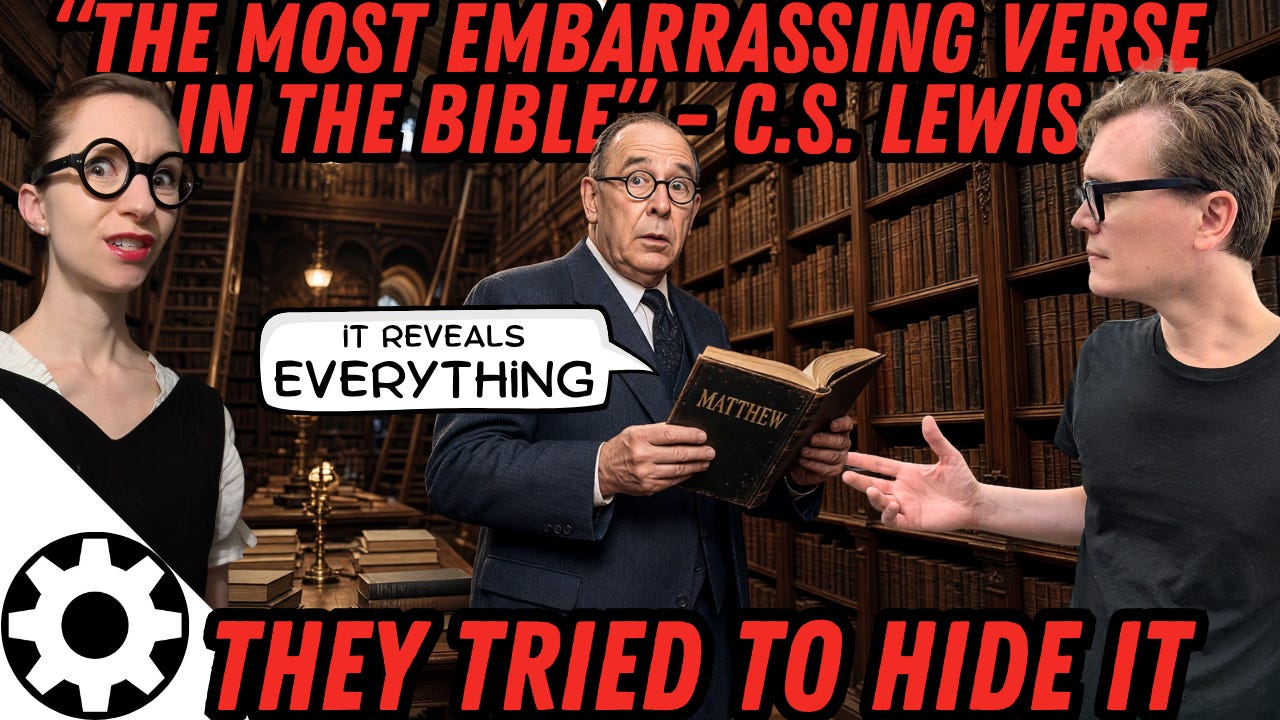
C.S. Lewis’ “Most Embarrassing Verse” Proves the Bible’s Authenticity
Note: Big mistake in the original corrected now C.S. Lewis was Anglican not Catholic. I was late getting the episode out and I erred on the side of trying to appease people who have us in their morning routine and not of double checking. I was thinking of Tolkien and because C.S. Lewis is always brought up by my Catholic friends in debates. In my defence Anglican is a hair away from Catholicism.
Today on Based Camp, we dive deep into Mark 13 and related passages, examining the line C.S. Lewis called “the Bible’s most embarrassing verse.” Our discussion explores how Jesus’ predictions about the temple’s destruction align with historical events in 70 CE, the reasons certain phrases were altered in early manuscripts, and why modern apocalyptic readings may overlook the original context. We also contrast traditional interpretations with a focus on textual and historical analysis, including connections to Daniel and the broader implications for understanding early Christian prophecy. Hope you find the analysis as interesting as we do!
Further Reading
https://technopuritan.com/this-generation/
https://technopuritan.com/sabbath/
https://technopuritan.com/assembly/
Episode Transcript
Malcolm Collins [0:00]:Hello, Simone. I’m excited to be here with you today. Today is going to be a fascinating episode. We will be going over a line that CS Lewis called the most embarrassing line in the bible.
Speaker 6 [0:14]:For those unaware, CS Lewis is the extremely pro Christian apologist who wrote the Narnia series.
Malcolm Collins [0:20]:We are going and it
Simone Collins [0:21]:is connected to another line that the writers of the bible erased in most translations. It was considered so embarrassing. Erased? Wait. So they’re like, I’m Samuel Johnson, whatever, and I’m translating the bible. And I’m I get to this one line and I’m like, oh.
Malcolm Collins [0:43]:It’s it’s funnier than that. Really? Syntax Synaiticus, who was a scribe from the year 300. Okay. What we have from him is a bible because, you know, scribes would copy a bible. And so this was as as far back as the year 300. And we see this line with dots over it, which means erase this line, and then somebody erased the dots. And so what this
Simone Collins [1:12]:So it was to, like, remove the fact that we didn’t even know what was being removed.
Malcolm Collins [1:16]:No. What this is a sign of is two scholars three hundred years after Christ having a fight about whether or not this line was so embarrassing it needed to be removed.
Simone Collins [1:27]:Wow. Well, in terms of that historical Jesus lecture series that I’m obsessed with, something that’s embarrassing to Jesus or people who wanna believe in Jesus is probably more likely to be true. Right? But here’s the kicker. Okay.
Malcolm Collins [1:40]:All of these lines, if you keep them in Yeah. Are some of the best and most unbelievable prophecy and proof that the Bible has inspiration.
Simone Collins [1:53]:And this is why you shouldn’t try to cover up what may seem like flaws because you don’t know. You don’t know.
Malcolm Collins [1:58]:Einstein did the same thing. He tried to, in his math, if you’re familiar with this, famously, he couldn’t explain something. He’s like, but then that would mean you could have it go into the negatives. And if it went into the negatives, that just doesn’t make sense. So I’m gonna say it never does that. and then it turns out, like, forty years later, actually, that was a prediction of a major part of how physics works.
Speaker 9 [2:20]:Specifically here, when Einstein first finished general relativity and applied it to the universe as a whole, the equations naturally allowed the cosmos to expand and contract. At the time, that seemed physically absurd to everyone, including Einstein, assumed the universe was static and eternal. So he added an extra term, the cosmological constant, whose job was to counteract gravity and keep the universe from changing size. He later called this his greatest blunder and dropped the term after Hubble showed an ex the universe was actually expanding. Decades later, in 1998, supernova results revealed that the expanse was accelerating, that term came back as the simplest description of dark energy, the dominant component in the universe today. The ugly patch he inserted to stop the mass from doing something that, quote, unquote, didn’t make sense turned out to be a genuine prediction.
Simone Collins [3:14]:Exactly. Yeah. Don’t yeah. Just because something seems like a truth seems difficult doesn’t mean it’s not the truth.
Malcolm Collins [3:22]:Yeah. Something to hide. And I will note if you’re like, oh, well, maybe it was actually a wrong line, and it needed to be erased. And this was the line that the sun would not see the end of times coming. That’s specifically the line they tried to erase in this larger section that we’ll be reading. It’s in Mark. It’s all over Mark. It’s only in Matthew where they erased it, which has basically an identical scene take place. And people can say, wait. Wait. Wait. Wait. Wait. Why did they erase it from Matthew and not Mark?
Simone Collins [3:54]:That’s a good question.
Malcolm Collins [3:55]:Yeah. Why? Very interesting little mystery to start with. The answer is is because Mark was almost never read. and you can say, wait. That’s confusing. Isn’t Mark the oldest of the bibles? Yeah. Isn’t Mark presumably the most closest to accurate of the Bibles? Right? Well, yes. That is true. but that created a problem, which is if the other Bibles are copying Mark and adding stuff to Mark, they would seem like if you’re a scholar or a researcher and you wanna talk about what’s in the bible, there’s no reason to read Mark because Mark is covered by everyone else because everyone else is copying and expanding on Mark.
Speaker 10 [4:42]:Note here, it used to be thought that John did not have access to Mark, but now we think he did have access to Mark. He just didn’t really rely on it as much as the other, gospels.
Malcolm Collins [4:56]:So and and worse than that, Mark doesn’t have a lot of the stuff you wanted to have. It doesn’t have Jesus coming back after death. it only has an empty tomb. it doesn’t have a a virgin Mary birth. It doesn’t have Jesus giving the the church or any any signs, not even the the scant signs that we see in other texts, anything about Peter supposed to be running the church afterwards. And so it just wasn’t useful for Catholic authorities or scholars to debate about. And so they basically forgot it. And so it didn’t get covered up there in the same way
Simone Collins [5:31]:Oh, dear.
Malcolm Collins [5:32]:Which is how we know that isn’t just like a scholarly misunderstanding. This was almost certainly in the earliest version of this.
Simone Collins [5:37]:Wow. Oh my goodness. This is fascinating.
Malcolm Collins [5:42]:Yes. So here, I’m gonna read the CS Lewis line in context. Okay. And this line is one that Simone is very familiar with because she has cited it in past episodes. I think even in past tracks. And I’m always like, Simone, you need to stop listening to the historic Jesus scholars here. You need to read the line in context and see if it makes sense Okay. Which I don’t think you ever went back and did.
Simone Collins [6:04]:No. Because I still haven’t made it to the New Testament. Get me taught. The Old Testament’s big. It’s very big. It’s That that’s not</
You May Also Like

Estelle Midi
RMC

Madrid es noticia
esRadio
The Unmistakable Creative Podcast
Srinivas Rao
Money Making Conversations Master Class
Rushion McDonald
Podcasts | The Survival Podcast
The Survival Podcast
Woman's Hour
BBC Radio 4

綠豆搞Bean科
綠豆 Green Bean Media

How Men Think
iHeartPodcasts

Stuff They Don't Want You To Know
iHeartPodcasts

Rogue Energy
iHeartPodcasts
Estelle Midi
RMC
Madrid es noticia
esRadio
The Unmistakable Creative Podcast
Srinivas Rao
Money Making Conversations Master Class
Rushion McDonald
Podcasts | The Survival Podcast
The Survival Podcast
Woman's Hour
BBC Radio 4
綠豆搞Bean科
綠豆 Green Bean Media
How Men Think
iHeartPodcasts
Stuff They Don't Want You To Know
iHeartPodcasts
Rogue Energy
iHeartPodcasts
Community discussion