Explained: Why the Left Platforms Bad Actors
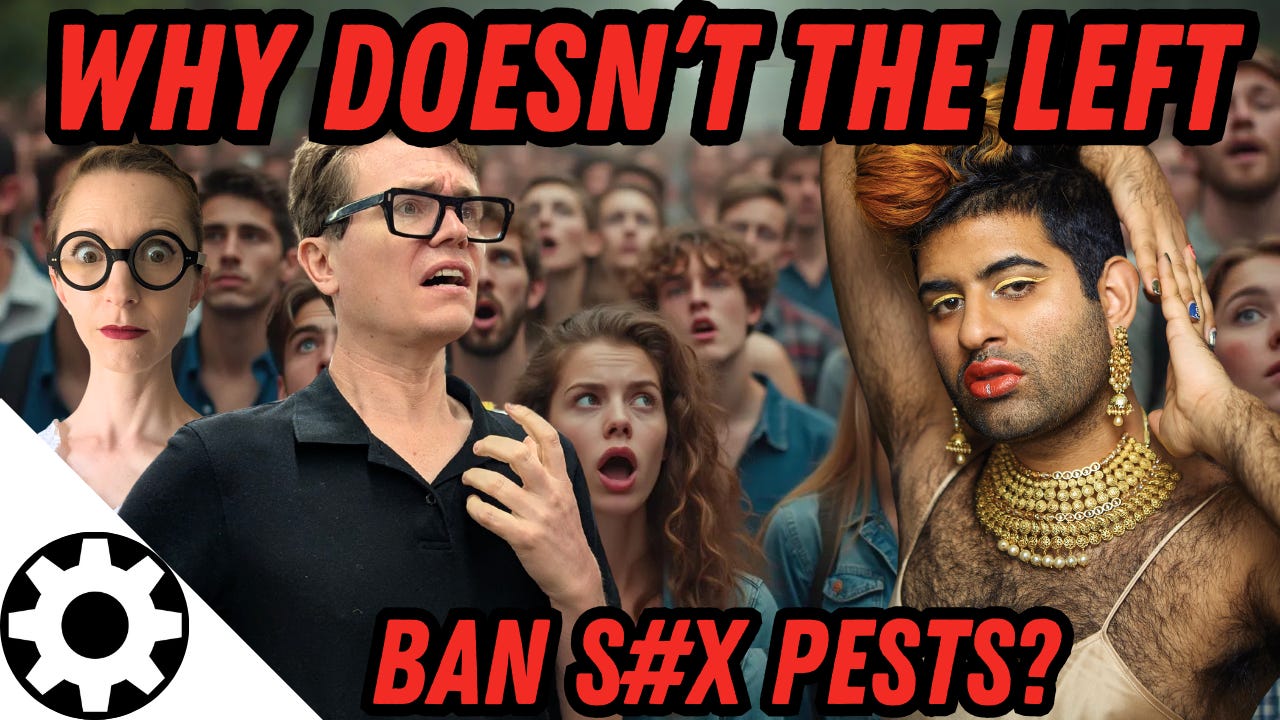
In this episode, we delve into a new theory which questions why the mainstream urban monocultural woke LGBT side of the movement doesn't disown certain controversial individuals. We discuss various historical and contemporary examples, such as Leah Thomas and Alec Va Menon, to highlight how some individuals may exploit trans identity. The conversation also touches on the idea of an enforcer class within the movement that actively targets potential defectors. We critique the impact of these dynamics on both the trans community and wider society, and hypothesize the potential evolutionary benefits and drawbacks. The discussion concludes with reflections on how different cultural norms and behaviors might be tools for identifying and rooting out dissenters.
Simone Collins: Hello Simone. I'm excited to be here with you today. Today we are gonna be talking about a new theory that I had that explained something that had always kind of troubled me, which is why did the mainstream sort of urban monocultural woke LGBT side of that movement? Why did they not disown the sort of degenerate sex PEs types?
When it would turn out that someone that they had pedestal was in that category, or why would they even, was pre-knowledge that somebody was within this category of, of trans why were they not like, oh, well, you know, of course it's, that's not what we're fighting for. You know, this is just, you know, one individual.
This is just, this is an example of like what we don't want. Right. You know? And, and this is something that, that historically other groups did push back against, you know, you, you look at you know, some of the early, like, gay stuff and, and they pushed back against, you know, the, the classic example of like Mr.
Garrison and Mr. Slave trying to get fired by being the over the top outlandish, .
Speaker 10: dun, dun, dun, dun dun, dun, dun, dun, dun, dun, dun, dun, dun. Get along little slave!
Speaker 11: Oh my god!
Speaker 10: That's what our boys were talking about! Ding, ding, ding, ding! He is so courageous!
Speaker 11: But you know what makes me even happier? Sucking balls! Hmm.
Simone Collins: And a lot of gay people historically, like when I was involved in the GSA movement back in the day and everything like that they were really against this stuff. They, they, they, they were against it to the extent that it was framed as being, you know, homophobic to, to act this way because you were creating this negative stereotype of their community.
Mm-hmm. And true. It, it makes your job harder if you accept and pedestal. These sorts of individuals and you would assume that your average person, instead of, you know, going to bat for these people would instead say oh, well that's not, you know, I'll give some examples of this. It always really get me the, the Leah Thomas.
I know it's like anyone, you could argue that, you know, Leah Thomas was not. A central figure of the trans movement in the United States. She was the trans high school swimmer male to female who then, you know, won a bunch of stuff and people were like, Hey, this is totally unfair. When she was a male, she was like losing everything.
And now she's winning everything. And this seems like she had the biological advantage and most people were like, yeah, I mean, pretty obviously. But it, it came out pretty quickly afterwards that she in her locker was flashing what most people would perceive to be male genitals. At the other girls in the locker room this was an accusation that was made in a number of prominent places.
She never, despite speaking adjacent to this accusation, never denied it, never spoke against it. The argument was always like, well, you know, girls have the right to be naked in front of other girls in the, in the locker room, and I'm a girl now, which to me indicates this isn't like some unverified report.
This is something that was definitely happening, right? Like it's also.
Malcolm Collins: I would note that in my entire experience on a swim team, from like middle, all the way through high school. I never saw a naked girl. I, I wanted showered in her
Simone Collins: swimsuits. This is, this is also a really important point. So these days, even, even to an extent to our childhood, but, but, but especially these days.
'cause this is a trend that's been a amplifying intergenerationally. Mm-hmm. It is not culturally normal in American high schools to be naked in the locker room in front of other kids. Mm-hmm. Like what did you do after swim meets? And this was a long time ago before Curtis told you, you told me.
Showered in the swimsuits, right? We showered
Malcolm Collins: in our swimsuits. That's absolutely the case. And you would, you know. Actually shower again and like change clothes at, at home. And also if you went to the bathroom, you wouldn't even like, you wouldn't pull off your swimsuit, you'd pull the bottom aside and pee.
Simone Collins: Yeah. And I never as a, as a man, and this is even a while ago, so this is like 20 years ago, and it's gotten much stricter to the extent that they do private showers on high schools now and stuff like that. When they build new ones, 'cause they go, we build the public ones. Nobody uses them. I don't think I ever saw more than like one or two naked boys.
And this was, and, and this would always be tied to like a very specific sport where it was normalized.
Malcolm Collins: Yeah. When we talked about this in another episode, a lot of the people in the comments pointed out that like one exception where it just seems to be. Even obligated is wrestling teams. But I, I get it.
Like at that point, it's like I was on wrestling
Simone Collins: teams. I didn't see it that much. Really? I could, could see it though. Like you get actually sweat and gross
Malcolm Collins: lacrosse teams, so
Simone Collins: I
Malcolm Collins: could
Simone Collins: see people being
Malcolm Collins: like, because the lacrosse teams
Simone Collins: would get actually sweaty and gross. Yeah. Yeah. But like, you don't get that with swimming.
With swimming, it's, it makes sense that you're, you just came out
Malcolm Collins: of a. Chlorinated pool. I mean, you, you wanna rinse off the chlorine? No. The
Simone Collins: point being is your outfit that you swam in is meant to get wet. Yeah. Like that is why it's so normalized to just shower in your swim outfit because it also needs to be cleaned off.
Mm-hmm. Yeah. So the point being is this is an individual who is doing something that was not culturally normal. They were flashing people intentionally. Mm. Okay. ,
Speaker 17: Ah!
Simone Collins: And not, not a single person on the left I saw was like, Hey, we should stop pedestal, this person. Mm-hmm. This is clearly a sex pe who is just getting off on violating other people's consents and using a trans identity to do that.
Like, and as I've always pointed out, if you create an identity like transness and you say, okay, well we do wanna protect people who, who have this condition, right? And we don't want them to be othered. Of course if you say, and to do that, we're gonna say they're not allowed to be criticized for like anything they do.
Of course, sex PEs are gonna use that. Like you and I remember sex PEs from high school, like the sex PE boys, if they had had the option to use this and go into women's restrooms and you know, pressure women. They would've a
You May Also Like

Daily Inspiration: The Steve Harvey Morning Show
Peter Mutua

RADIO KULTURAEUROPA
RADIO KULTURAEUROPA

How Men Think
iHeartPodcasts

During the Break with Clint Powell
Clint Powell

Keeping It Real: Conversations with Jillian Michaels
Jillian Michaels

Coach Corey Wayne
Coach Corey Wayne

CAMINANDO POR EL MEDIO
Radio Trend Topic

Am I the Jerk?
youtube.com/amithejerk

Es Noticia
esRadio

Fulda Kultur - Der Podcast
Fulda Kultur / Shaggy Schwarz
Daily Inspiration: The Steve Harvey Morning Show
Peter Mutua
RADIO KULTURAEUROPA
RADIO KULTURAEUROPA
How Men Think
iHeartPodcasts
During the Break with Clint Powell
Clint Powell
Keeping It Real: Conversations with Jillian Michaels
Jillian Michaels
Coach Corey Wayne
Coach Corey Wayne
CAMINANDO POR EL MEDIO
Radio Trend Topic
Am I the Jerk?
youtube.com/amithejerk
Es Noticia
esRadio
Fulda Kultur - Der Podcast
Fulda Kultur / Shaggy Schwarz
Community discussion