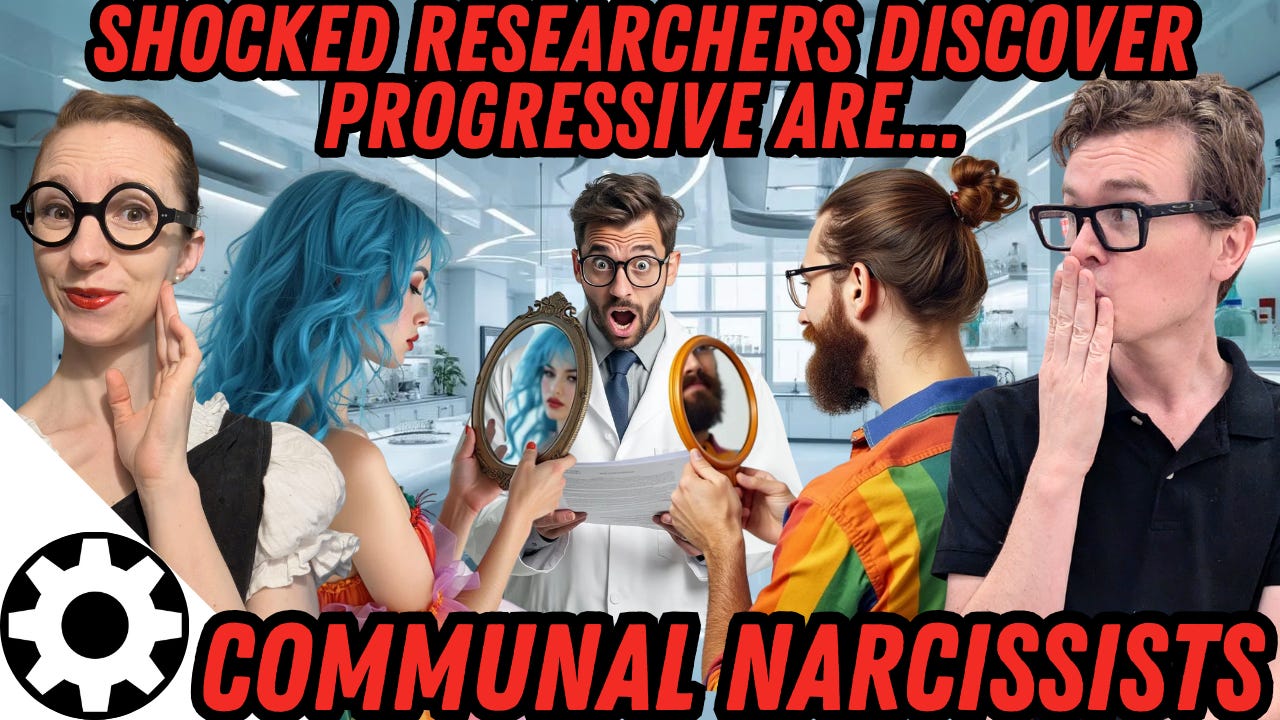
Newly Discovered Narcissism Type Explains the Left
In this video, we dive into the concept of Communal Narcissism, a newly identified phenomenon where individuals within leftist communities exhibit narcissistic traits. Through an article by Brett Parley and Keith Thompson, we explore how communal narcissists seek validation through their contributions to social groups rather than personal achievements. The discussion highlights the surprising presence of grandiosity and entitlement among those previously considered healthy. We also touch on the dynamics of in-group signaling, the historical context, and the broader implications of such behavior for societal discourse and power structures. Join us in unpacking this intriguing topic!
Malcolm Collins: [00:00:00] Hello Simone. I'm excited to be here with you today. Today we are going to be going over an article called Communal Narcissism, which dives into a new phenomenon that scientists are discovering where it turned out.
That the way, say that they scientists change their methodology a bit and go, oh my God, I, I, I found something shocking. It turns out that there is narcissism within leftist communities. How did I. How did, how did all of our old studies not pick this up? But it is a, a new phenomenon and so we're gonna be going over an article that was written by Brett Parley and Keith Thompson that explores this phenomenon and how it is being sort of tracked and elucidated by scientists.
And obviously I'm gonna do what I normally do, which is not read the entire article, just read the parts that I think are interesting to, to learn about. 'Cause obviously it starts just talking about what we all know is that the left is shockingly narcissistic in many ways and like going into when they all put up black squares or like pride flags over there.[00:01:00]
There are pictures. Do you remember when that used to be like a thing? And in college, I remember like when it would happen, I'd be like, afraid not to do it. I'd be like, oh my God, I have to do it. Or everyone's gonna say because if all your friends have it up, everyone's gonna be like, ah, this is proof that you are homophobic.
I already had suspicions that you might be a conservative or have conservative sympathies. And so, you know, trying to start my career I had to, I had to go as the go, as the flow. I love some people, like I would never do that. And it's like, well, you know, I, I do support like general gay rights, right?
So I, I should, I guess change my profile. But let's continue here. Examining the literature on clinical narcissism in the time of Trump, we discovered something surprising. Researchers had been certain that they would be able to distinguish healthy individuals from those suffering from the new condition.
What gradually dawned on them was that many of the individuals they had been scoring as normal were in fact, exhibiting vanity, grandiosity and [00:02:00] entitlement the hallmark traits of self-centered narcissistic displays. Very overtly and actually even more overtly than the ones who they were categorizing as narcissists.
Of course, the pathological aspects of the new condition announced themselves in markedly different words and gestures. It had previously been assumed that these characteristics were healthy, unlike the well-known characteristics of over art narcissism so readily apparent in people like Trump remark, and I would say that people are like, oh my gosh, how dare you call Trumper?
Nurse. I mean, come on. Like we can be conservatives and still be like the guy's a little narcissistic. But anyway, to continue here remarkably the experts nearly missed telltale signs of what they would go on to characterize as communal narcissism, communal indicating that individuals seek validation and admiration through their perceived contributions to social groups or communities rather than through personal achievements.
So. What this new form of narcissism is, is [00:03:00] narcissism about like. I'm always a good person. I always do good things. I always contribute to my community in the night, in, in the correct way. Mm-hmm. And it is through constant signaling of, of sort of in group when you are. Convinced that that in group is the only group that really matters.
Mm-hmm.
Which you see among you know, progressives was like Hillary Clinton calling the others the deplorables. You, you really, as somebody who used to be a progressive, I remember the way that they think. And it is really that the other, anyone who isn't within their social. Alignment, this urban monocultural alignment is really sort of not human.
Exactly. Not really. Absolutely. Worth considering or thinking about.
Simone Collins: Yeah. Subhuman like too, too ignorant to be really considered a peer. Yeah.
Malcolm Collins: Yeah. But is that not like classical narcissism? To, to consider only this one group as mattering and dedicate your life to this one group and everything that they [00:04:00] do is axiomatic good because they are the ones doing it.
To our surprise and that of the researchers themselves, communal narcissism turns out to be the equal and opposite variant of the self-centered, overt type in which individuals boast about being quote unquote the best. Joshin Gerber's 2012 paper in the Journal of Personality and Social Psychiatry introduced the agency communal model distinguishing agentic narcissists who boast of their intelligence and achievements from communal narcissists who claim to be the most helpful or virtuous.
Isn't that a fascinating way to, to, to delineate the two groups? Basically, if you have this narcissistic trait and you are age agentic. You become this sort of overt narcissist. Yeah, I'm the best, I'm the greatest. Right. Because you are, you both think that you are the greatest and you think for yourself which is in a way morally superior to the communal narcissist who is non-ag agentic, but thinks that they are great and everything they do is good.
[00:05:00] So they just align themselves with a preexisting, often what they see as the dominant cultural group. And well, it seems to
Simone Collins: me like a, this is a new. Iteration of the Karen, what you're describing, because the Karen is also that like, I am the HOA president, like I represent our community. You are ruining this.
You can't park here, you can't do this. And the, the classic Karen archetype is someone who believes that they are in the right and speaking on behalf of their community. And not based on some individual evaluation, but based on what they believe to be normatively correct.
Malcolm Collins: I really found the way she put this interesting. This is a form of narcissism where instead of thinking you are the main character and the most important person and nobody else's thoughts, feelings, perspectives really matters. You think that your community is the only one that really matters and no other community, thoughts, perspectives, et cetera, matters, and that you are an avatar of that community.
[00:06:00] Well, yeah. I think that the Karen is a version of this, but I think that the higher version is the Twitter person or something like that, because the Karen had to go out and run for office and everything like that.
Mm-hmm. She wasn't just reflexively reacting to whatever group she thought was the biggest in her environment. I think that the the, the better proto iteration of this. Was like the Satanic panic bomb, the the Christian Pearl clutching mom when Christians were the dominant social group in America.
And, and instead of the urban monoculture, and this individual would just, and, and these likely exist, was in some communities where, where Christianity or Mormonism is still the dominant group where they just reflexively. Pearl Clutch and, and, and pull themselve
You May Also Like

Daily Inspiration: The Steve Harvey Morning Show
Peter Mutua

RADIO KULTURAEUROPA
RADIO KULTURAEUROPA

How Men Think
iHeartPodcasts

During the Break with Clint Powell
Clint Powell

Keeping It Real: Conversations with Jillian Michaels
Jillian Michaels

Coach Corey Wayne
Coach Corey Wayne

CAMINANDO POR EL MEDIO
Radio Trend Topic

Am I the Jerk?
youtube.com/amithejerk

Es Noticia
esRadio

Fulda Kultur - Der Podcast
Fulda Kultur / Shaggy Schwarz
Daily Inspiration: The Steve Harvey Morning Show
Peter Mutua
RADIO KULTURAEUROPA
RADIO KULTURAEUROPA
How Men Think
iHeartPodcasts
During the Break with Clint Powell
Clint Powell
Keeping It Real: Conversations with Jillian Michaels
Jillian Michaels
Coach Corey Wayne
Coach Corey Wayne
CAMINANDO POR EL MEDIO
Radio Trend Topic
Am I the Jerk?
youtube.com/amithejerk
Es Noticia
esRadio
Fulda Kultur - Der Podcast
Fulda Kultur / Shaggy Schwarz
Community discussion