P***phelia & Pronatalism: How Whites Crashed Global Birth Rates By Banning ****
In this raw and data-packed episode of Based Camp, Simone and Malcolm Collins ask a provocative question: Are Europeans the only people on Earth historically into adult pairings?
While most cultures around the world historically married in the early-to-mid teens, Europeans (especially Northern and Western) stood out by commonly delaying marriage until the mid-20s — even in the Middle Ages. The hosts explore whether this European norm, later exported globally through colonialism and cultural influence, may be contributing to today’s fertility crashes in East Asia, Latin America, India, and beyond.
They dive into:
* Aella’s “Hotness Curve” study and what percentage of men find different ages attractive
* The e-girl phenomenon and why so many popular internet aesthetics look phenotypically 15
* Genetic and regional differences in fertility windows and menopause age (Europeans go into menopause ~2–3 years later on average)
* Historical first-marriage ages across Europe, China, India, Japan, Korea, Africa, and the Americas
* Global ages of consent today and when different countries criminalized CSAM
* Disney princess ages (Snow White was 14, Jasmine 15, Ariel 16…) and why normalizing teen marriage might be necessary for demographic survival
This is a no-holds-barred, truth-seeking conversation about culture, biology, attraction, and whether some populations are simply not built for the modern delayed-marriage timeline.
If you’re interested in pronatalism, human biodiversity, evolutionary psychology, or why fertility is collapsing everywhere except where European norms never fully took hold — this episode is for you.
Show Notes
Aella’s Findings
Aella also just released a substack post titled The Hotness Curve (how age changes a woman’s appeal).
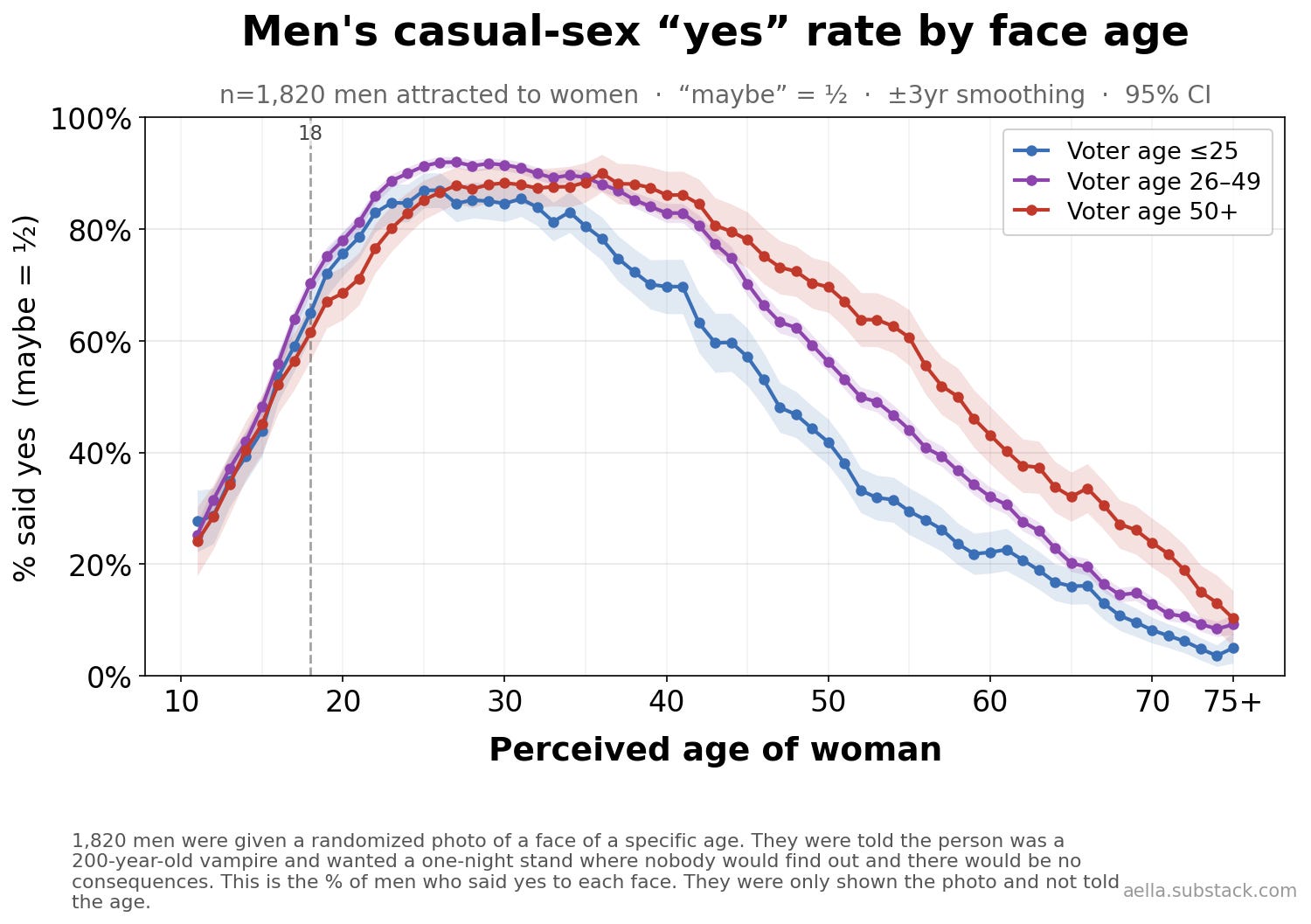
Using photos of women of various ages (some real, some AI generated), Aella asked various questions, including: “Casual Sex: A 200 year old vampire shows up in your window at night. She wants a one-night stand. There are no consequences, and nobody will know. Do you say yes?”
Here are the answers:
Aella found that “Sexual interest climbs very fast, and generally hits a cresendo around women who appeared to be ~24 years old (or 28yo for the older men).”
“15% of men said yes they would have casual sex with a vampire in the body of an 11 year old. This rose to a third of men for the body of a 13 year old, and a half of men agreeing to the body of a 15 year old. By 18 we’re at roughly 70%, and by the time a 24 year old is hypothetically entering your window, ~90% of them were down.”
Just a small aside: “One interesting thing to note is that the dropoff in fuckability for women - what we might call The Wall - happens for women in their mid 30’s just as predicted, but only in the eyes of men under the age of 25. For older men, we find the ‘wall’ occurs in a woman’s early 40’s. Older men assigned equivalent ‘yes I’d have sex with her’ ratings to an 18 year old as they did to a woman in her early 50’s!”
Also: You should play Aella’s ageguesser game.
(Simone got better than 67% of players… not very good.)
The e-girl phenomenon
From our friend Bruno: “Why does a certain “e-girl” or “internet girl” face seem to resonate so consistently with online audiences across different eras? Highly recognizable women in online subcultures seem to converge around a similar look; why does that look perform so well with netizens?
Early internet figures like Boxxy, later YouTube personalities like Shoe0nHead, cosplay and streamer-adjacent figures, and then more recent cases like Belle Delphine and the current wave of TikTok, cosplay, and Twitter/X e-girl aesthetics. The more interesting question is why a particular facial and stylistic grammar keeps recurring: large expressive eyes, youthful proportions, soft or rounded features, dark hair or bangs, a slightly anime-coded presentation, and a mix of cuteness, irony, awkwardness, and sexual ambiguity.”
Malcolm’s first answer: BECAUSE THEY ALL LOOK LIKE LITTLE GIRLS AND PEOPLE ARE PEDOS.
The sick sad truth: Most of the world is full of pedos
Basically, Europeans are the only non pedos.
Maybe the concept of pedos wouldn’t exist if it weren’t for Europeans
Maybe a contributing factor to falling birth rates involves modern norms around late marriage among groups that, for hundreds of years, married much younger.
Let’s explore this!
Variation in Fertility Windows
A large meta‑analysis across 24 countries estimated the global mean age at menopause at 48.8 years, and by continent:
* Europe: about 50.5 years
* Asia (overall): about 48.8 years
* Africa: about 48.4 years
* Latin America: about 47.2 years
* Middle East: about 47.4 years
WHO similarly notes that most women worldwide experience menopause between ages 45 and 55.
Variation in Average Ages of Marriage
Average female age at first marriage, approximate, pre‑1800
* England (pre‑1800) - ~22–26 - Many parishes ~25–26; Western Europe relatively late.
* Western/Northern Europe - ~20–25 - Late marriage pattern; some locales up to 27.
* China - ~14–18 - Legal norms ~14–15; practice mid‑teens.
* India - ~12–16 - Strong early arranged marriage; big regional variation.
* Japan - ~17–19 - Village data show late‑teen marriage.
* Korea (Joseon) - ~16–18 - Upper‑status women mid‑teens; similar for many commoners.
* Aztec/Nahua - ~14–17 - Girls early‑mid teens; men ~18–22.
* Maya - ~16–19 - Most married by ~20; post‑15 coming‑of‑age.
* Sub‑Saharan Africa (major) - ~15–18 - Many societies mid‑late teens for women.
Sources:
* https://journals.sagepub.com/doi/10.1177/036319907800300103
* https://www.sciencedirect.com/science/article/abs/pii/S1081602X08000894
* https://historymyths.wordpress.com/2014/07/06/myth-136-women-married-very-young-in-the-olden-days/
* https://keatschinese.com/china-culture-resources/general-standards-of-ancient-chinese-marriage-age/
* https://childmarriagedata.org/country-profiles/india/
* https://www.aztec-history.com/aztec-society-family.html
* https://mayas.mrdonn.org/marriage.html
Ages of Consent
In the most populous countries:
* Pakistan - 18 (requires marriage)
* India - 18
* Indonesia - 18
* Nigeria - 18
* Japan - 18
* Ethiopia - 18
* Egypt - 18
* DR Congo - 18
* Turkey - 18
* United States - 16-18 Varies by state
* Philippines - 16 (general), 14 for close‑in‑a
You May Also Like

How Men Think
iHeartPodcasts

Am I the Jerk?
youtube.com/amithejerk

Con ánimo de lucro
esRadio

Estelle Midi
RMC

Madrid es noticia
esRadio

The Ranch Podcast
Matt Todd

The Unmistakable Creative Podcast
Srinivas Rao

Money Making Conversations Master Class
Rushion McDonald
Podcasts | The Survival Podcast
The Survival Podcast
Woman's Hour
BBC Radio 4
How Men Think
iHeartPodcasts
Am I the Jerk?
youtube.com/amithejerk
Con ánimo de lucro
esRadio
Estelle Midi
RMC
Madrid es noticia
esRadio
The Ranch Podcast
Matt Todd
The Unmistakable Creative Podcast
Srinivas Rao
Money Making Conversations Master Class
Rushion McDonald
Podcasts | The Survival Podcast
The Survival Podcast
Woman's Hour
BBC Radio 4
Community discussion