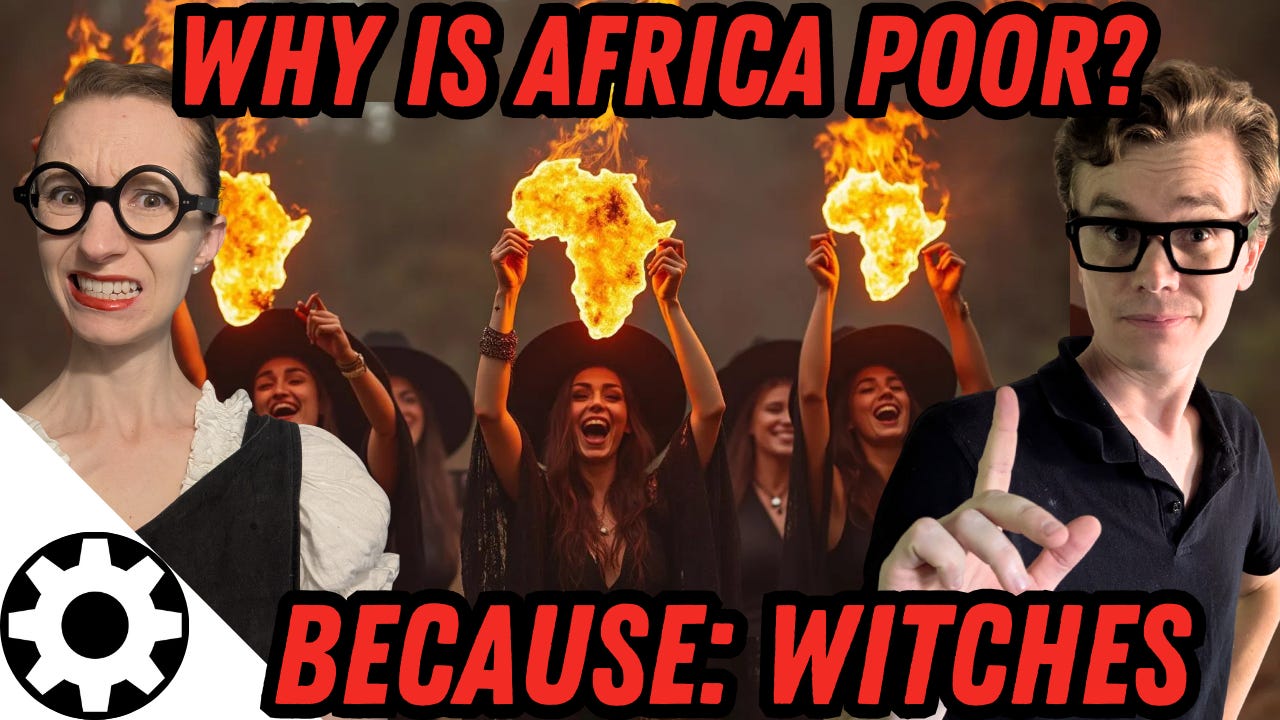
The Economics of Witchcraft in Africa
In this episode, we dive into the economic impacts of belief in witchcraft across various African societies. We examine multiple academic studies and articles highlighting how these beliefs permeate even educated and affluent demographics, influencing everything from entrepreneurship and governance to public health. Through the lens of these studies, we explore how such beliefs contribute to external locus of control and discourage rational problem-solving methods essential for economic development. The discussion spans across different African countries, revealing the deep-seated cultural contexts that impact societal progress and governance.
Malcolm Collins: Hello Simone. Today we are gonna be talking about a spicy topic. Oh no. Which is how belief in witches economically holds back Africa.
And we will be going over a, a number of articles on this. One is a great por piece, which is. How belief in which it holds Africa back or something like that. Oh, we'll get to in a second. Okay. Actually, I'll start with a quote from it because people might be hearing this and I think the way their brain is translating it is poor, uneducated people in Africa believe in which is, and these people are arguing somehow this affects everyone.
That is not what we are arguing here. Okay. So to quote from the article one might assume that formal education would provide a safeguard against magical thinking. However, research suggests that schooling alone is not sufficient. In a 2014 study, Henry Ryman and colleagues compared cognitive ability in epistemic rationality in Nigeria.
And Germany, they found belief in supernatural forces was prevalent. Even among the educated Nigerians. Surveys of African University students have reached similar findings In a sample of Nigerian students, many argued that western countries were more technologically advanced because they possessed magical powers that they refused to share was Africans, now I should note here, this came from a study called Witchcraft in African Development, Eric Cher. And it was published in 2014. So this is an academic study that goes and asks Nigerian college students, why are western countries wealthier? And their answer is, they have magic. They haven't shared with us that, that this is college students.
Nigeria. That's pretty wild. I wanna, I wanna clarify that the, the Afro Barometer survey shows that in some countries, educated people are more likely to believe in witchcraft, not less. These results underline that. The education system. So, so if you, this comes from a study called Power Politics in the Supernatural, exploring the role of witchcraft beliefs.
In gover for Government's development by Joanna Selfie Elson, Dan Bke and Bob Face. And specifically in Malawi populations, they found 74% of the population believed that witchcraft is an integral part of daily life. And educated residents were more likely to be inclined towards disbelief than less educated residents.
Simone Collins: More educated is more like, that's so interesting. And actually,
Malcolm Collins: same with social status, more social status, but more belief in witches. Less social status rush belief in witches.
Simone Collins: That is completely the opposite of what I would think. How is this happening?
Malcolm Collins: Well, what you are mis receiving is what is associated with social status and what is associated with education.
And this is what the West fundamentally doesn't understand. They think if you go and you learn what they tell you in. Education, you know, more of what's true, not just more of the mindset of the dominant culture within that region.
Oh, and what's actually
happening is when they are educated and they are not the country bumpkin.
You, you haven't even heard of witches. Let me explain to you the complicated nature of witchcraft.
Simone Collins: You know, well, I mean, well, yeah. I mean, to your point, the. Universities of the United States start broadly speaking, where the urban monoculture reaches anyone who thus far had only gone to Catholic school or a religious school or homeschool or whatever.
And, and
Malcolm Collins: yeah. And I wanna be clear that I don't think that this is true of all African cultures and communities, but that it is true of any African cultures and communities is telling and, and, and, and could mean a lot in terms of the de the development of, economic systems within these regions and we'll get to how it ends up.
And, and what I mean by this, by brainwashing, there's actually a great Atlantic piece we have to do a, a piece on that's titled Get This, the Liberal Misinformation Bubble about use Gender Medicine, how the left ended up disbelieving the Science.
Simone Collins: Interesting. Okay.
Malcolm Collins: Atlantic. Wow. And, and, and specifically what the piece is on is the belief that you know, it increases a kid's li risk of taking their life if they don't go through gender transition.
And they point out here that actually the the SU Supreme Court case on this unveiled that that is just completely was out. Any evidence at all. All of the evidence for this is apparently fabricated when, or not fabricated, but it just doesn't hold up to the counter evidence that this isn't the case.
And this is what's admitted in, in court. But what I mean there is that is a religious belief. Which is spouted by people who have been indoctrinated within the university system or centers of power within our own society. So, you know, who are we to laugh at? You know, Africans who are believing in witchcraft when we believe that, you know, kids are less if you, if you, if you surgically mutilate a child and put them on puberty blockers, that they will be less likely to take their life, right?
That's something that anyone should be like, that doesn't sound true to me at all. But apparently, and, and I would put this in the context of you know, gendered non-content use the 2023 study that showed that of 13 year olds who are not content with their birth gender more than nine of 10 of them by the age of 23, are completely content with it.
So, you know, we know that, you know, at this stage, that is a phase from the evidence. Mm-hmm. You know. To keep going was the witch thing. 'cause let's talk about witches here. Arrests and evidence here. Now this I found really fascinating to learn about in mid 2024 Zambian Police. So this is mid 20, 24, December 20th, actually 2024.
So I guess late. In mid-December 2024, Zambian police arrested Justin Matis, Knabe 42 and Leonard Re 43 Zambian Village Chief at a lusca hotel room. Authority seized ritual items, a live chameleon sealed in a bottle, white powder, red cloth animal tail, along with multiple containers of traditional medicine.
They were charged with practicing witchcraft. They were hired by Nelson Banda, the brother of Fugitive, former MP Emmanuel JJ Banda, who escaped custody. They were trying to hex the president. Okay. They agreed sorry, the payment varied in reports, but they were paid at $7,400, around 43 million Zambian Kawa.
Wow. Although other testimonies suggested they could have been paid over a million dollars to cast these taxes. So, you know, high, high. Wealthy people, you know, brothers of mainstream politicians are hiring expert witches to cast things on other politicians, and we're talking well, and
Simone Collins: also it's illegal, whereas I don't think witchcraft is illegal in the us.
I. Because, or at least in most US states, because I think most US states don't think witchcraft is a thing. I mean, the very fact that they were arrested for it means that there is some understanding that, one, i
You May Also Like

The Latest with Loren LoRosa
The Black Effect Podcast Network and iHeartPodcasts

Daily Inspiration: The Steve Harvey Morning Show
Peter Mutua

RADIO KULTURAEUROPA
RADIO KULTURAEUROPA

How Men Think
iHeartPodcasts

During the Break with Clint Powell
Clint Powell

Keeping It Real: Conversations with Jillian Michaels
Jillian Michaels

Coach Corey Wayne
Coach Corey Wayne

CAMINANDO POR EL MEDIO
Radio Trend Topic

Am I the Jerk?
youtube.com/amithejerk

Es Noticia
esRadio
The Latest with Loren LoRosa
The Black Effect Podcast Network and iHeartPodcasts
Daily Inspiration: The Steve Harvey Morning Show
Peter Mutua
RADIO KULTURAEUROPA
RADIO KULTURAEUROPA
How Men Think
iHeartPodcasts
During the Break with Clint Powell
Clint Powell
Keeping It Real: Conversations with Jillian Michaels
Jillian Michaels
Coach Corey Wayne
Coach Corey Wayne
CAMINANDO POR EL MEDIO
Radio Trend Topic
Am I the Jerk?
youtube.com/amithejerk
Es Noticia
esRadio
Community discussion