US Indian Women Suffer High Rates of __ (The Why is Hidden)
Simone and Malcolm examine the Missing and Murdered Indigenous Women, Girls, and Two-Spirit (MMIWG2S) movement and the dominant narrative that frames high rates of violence against Native women primarily as the legacy of settler colonialism, racism, and systemic failures.
They dig into historical intertribal warfare and raiding practices, the actual circumstances of Sacagawea’s life (captured as a child, sold, and one of multiple wives of a fur trapper by age 16), National Institute of Justice and CDC data on perpetrators of violence and homicide, Canadian statistics showing the large majority of accused are Indigenous, reservation versus off-reservation patterns, tribal sovereignty and property rules, residential school claims, the smallpox-blanket episode in context, and internal corruption during the Trail of Tears.
The discussion challenges the “noble savage” framing, argues that most violence is intra-community, and questions whether preserving certain cultural and legal structures is helping or harming the people living under them. Strong language and dark historical accounts throughout.
Show Notes
Note: If you want to know how we’ve been gaslit about historical American Indians, watch Matt Walsh’s What Schools Don’t Teach You About American Indians
Another note: Acronyms: American Indian/Alaska Native (AI/AN)
There’s a movement called called MMIWG2S
I first learned about it, ironically, from TheHolyBall, because of his song MMIWG2SLGBTQQIA+
I was like… what is MMIWG2S?
MMIWG2S stands for Missing and Murdered Indigenous Women, Girls, and Two-Spirit people. It is a grassroots movement and a term used to describe and bring awareness to the severe, disproportionate rates of systemic violence, kidnapping, and murder faced by Indigenous communities across the United States and Canada
According to organizations like the Coalition to Stop Violence Against Native Women, violence against Native women and children is primarily framed as a legacy of Spanish and Euro-American invasion, settler colonialism, and continuing structural forces such as anti-Indigenous racism, bordertown violence, police brutality, and failures within the judicial system.
Wow, that sounds bad. Is it true? I thought that broadly speaking, most acts of violence and murder are committed by people with whom the victim is close.
National Institute of Justice Findings
The most cited national estimate is NIJ’s 2010 National Intimate Partner and Sexual Violence Survey analysis, published in 2016
* It found that 97% of American Indian or Alaska Native women who reported one or more of these forms of lifetime violence had experienced at least one incident involving a non-American Indian/Alaska Native or/interracial perpetrator; 35% had experienced at least one incident involving an AI/AN/intraracial perpetrator.
* These numbers do not mean 97% of incidents were committed by non-Indigenous people and 3% by Indigenous people. The categories overlap: a woman who was harmed by both an Indigenous and a non-Indigenous perpetrator appears in both columns. NIJ explicitly says its analysis measured whether someone had any interracial and/or intraracial victimization, not the count of incidents by each group.
* For scale, the same survey found that 84.3% of AI/AN women reported one or more of the measured forms of lifetime violence: 56.1% sexual violence, 55.5% physical intimate-partner violence, 48.8% stalking, and 66.4% psychological aggression by an intimate partner.
Per this report, what percentage of violence against american indian and alaska native women and men is committed by american indian and alaska native people?
* Among American Indian and Alaska Native people who had experienced the covered forms of violence, 35% of female victims and 33% of male victims had experienced violence by at least one American Indian or Alaska Native perpetrator (termed intraracial violence)
* The same report found that 97% of female victims and 90% of male victims had experienced violence by at least one non-AI/AN perpetrator.
About the National Institute of Justice: It’s the Justice Department’s research and evaluation arm
Older US Data
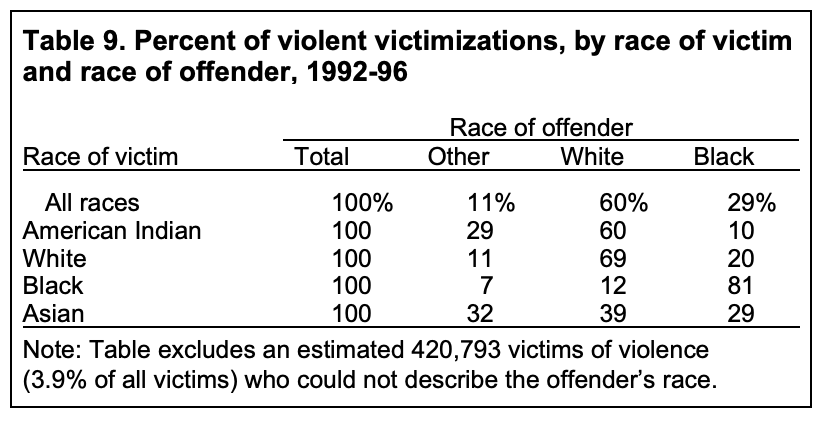
An older Bureau of Justice Statistics analysis, using 1992–96 National Crime Victimization Survey data for all American Indian victims, not women alone, estimated that individual violent-crime victimizations involved perpetrators described as:
* 60% White
* 10% Black
* 29% “other”—a category that combined American Indian and Asian perpetrators, though BJS said this group was likely predominantly other American Indians
IMPORTANT: This is an incident-based estimate, unlike the NIJ “ever experienced” figures
Table 9 from the report:
Why This is Suss
First: In the older report, they group native americans with “Asians” in a manner that could be done to reduce the percentage of crimes perpetrated by indigenous americans
Second: In the newer report, they group non-indigenous people with mixed-race people.
* Recall that the National Institute of Justice found that 97% of American Indian or Alaska Native women who reported one or more of these forms of lifetime violence had experienced at least one incident involving a non-American Indian/Alaska Native or/interracial perpetrator
* WELL WHAT PERCENTAGE OF PEOPLE WHO IDENTIFY AS AMERICAN INDIAN/ALASKA NATIVE ARE ALSO INTERRACIAL?
Third: In the newer report, they asked behavioral questions rather than using documented proof
How was data collected for this research?
* Interviewers called randomly selected landline and mobile-phone numbers.
* The relevant analytic sample included 2,473 AI/AN adult women and 1,505 AI/AN adult men, including people identifying as AI/AN alone or alongside another racial group.
* The survey used behaviorally specific questions about what respondents had experienced, rather than relying solely on respondents’ own labels for events—for example, questions about force or threats in sexual violence.=
What were the exact behaviorally specific questions used?
* The questions were asked in respondent-friendly language and were behavior-specific—for example, asking whether particular acts happened rather than asking “Were you abused?” The complete scripted 2010 questionnaire is publicly available from CDC
* Below are representative items/wording from the instrument, organized by what the AI/AN report measured. This is paraphrased rather than reproducing the full questionnaire verbatim.
* Physical intimate-partner violence: A partner slapping; pushing or shoving; pulling hair; hitting with a fist or object; kicking; slamming the person against something; trying to choke or suffocate them; beating; burning them intentionally; or using/threatening a knife or gun.
* Psychological aggression: An intimate partner acting dangerously; calling the respondent names, insulting, or humiliating them.
* Coercive control: Threats; interference with family or friends; restricting access to money; monitoring or controlling the respondent’s a
You May Also Like

Estelle Midi
RMC

Madrid es noticia
esRadio
The Unmistakable Creative Podcast
Srinivas Rao

Money Making Conversations Master Class
Rushion McDonald
Podcasts | The Survival Podcast
The Survival Podcast
Woman's Hour
BBC Radio 4

綠豆搞Bean科
綠豆 Green Bean Media

How Men Think
iHeartPodcasts
Stuff They Don't Want You To Know
iHeartPodcasts

Rogue Energy
iHeartPodcasts
Estelle Midi
RMC
Madrid es noticia
esRadio
The Unmistakable Creative Podcast
Srinivas Rao
Money Making Conversations Master Class
Rushion McDonald
Podcasts | The Survival Podcast
The Survival Podcast
Woman's Hour
BBC Radio 4
綠豆搞Bean科
綠豆 Green Bean Media
How Men Think
iHeartPodcasts
Stuff They Don't Want You To Know
iHeartPodcasts
Rogue Energy
iHeartPodcasts
Community discussion