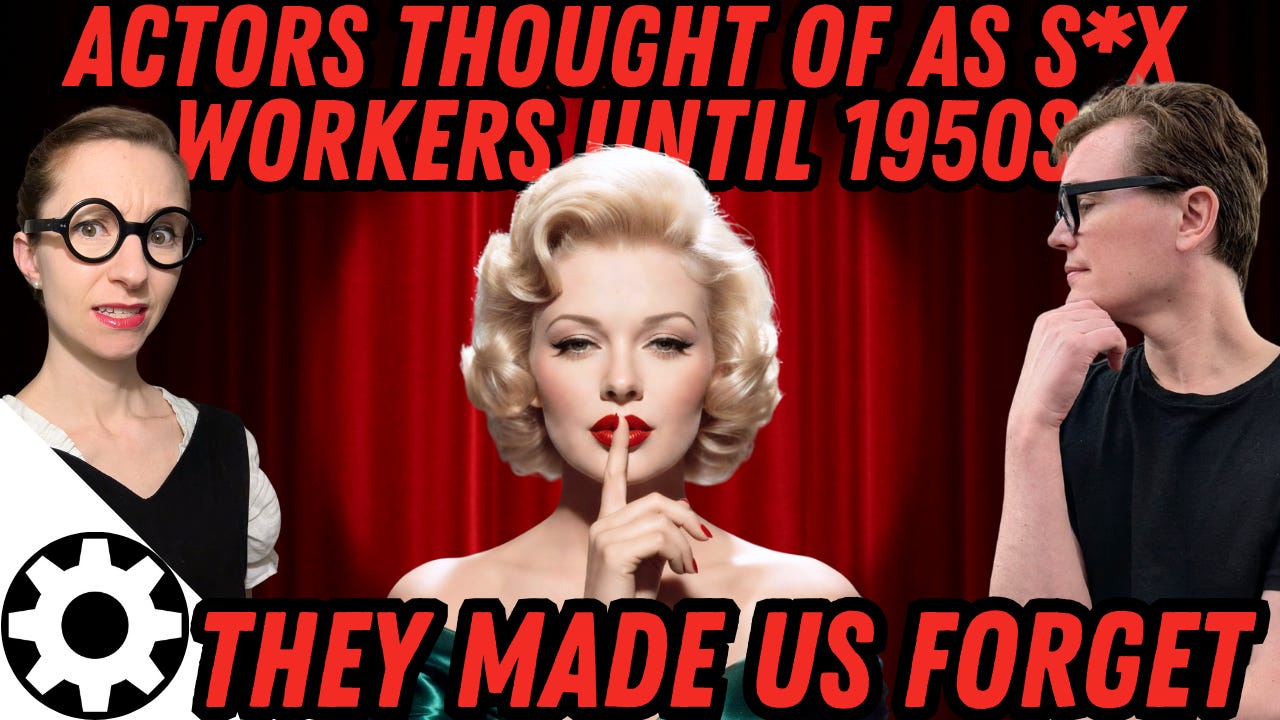
Why Actors Were Social Outcasts Until Recently
For most of Western history, acting was a low-status profession often linked with vagrancy, moral suspicion, and limited respectability. This episode traces how that reputation formed—from Restoration England and Victorian theater culture through early Hollywood—and why the public association between performers and social stigma lasted far longer than most people realize.
Drawing on historical research and primary accounts, the discussion covers when women first appeared on the English stage, how limited career options shaped public judgment, the slow professionalization of theater after the Civil War, and the modern shift that turned entertainers into trusted public voices. Key turning points include late-night television’s studio-era promotion machine and the legitimizing effect of a former actor reaching the highest political office. The conversation closes with a practical takeaway: how to choose role models and sources of life advice more carefully.
Episode Transcript
Malcolm Collins:Hello, Simone. I’m excited to be here with you today. Today, we are going to be talking about another part of history that has been hidden from people, which is that until very, very recently, actors and actresses were seen as the same kind of a thing as smex workers.
Simone Collins:Yeah. Yes. It shows up a lot in my regency era romances.
Malcolm Collins:It comes up a lot? Oh, yes. Yes. Yes. Yeah. Yeah. They don’t they’re like, how could you be with an actor? No.
Simone Collins:Well, they yeah. They’re basically roughly the same thing. Like, you you kind of understand, you know, if she’s an actress. That’s
Malcolm Collins:what she does. And what I will be going into in this particular episode is the reasons why this connection was made, but also tracking that the reasons why people originally well, let’s put it this way. The reason why one of the big reasons why is because actors were, one, literally selling their bodies, which they do to an even greater extent today. They often appear on stage naked on Yeah. Major movies
Simone Collins:and Kissing people for pay. For pay. Yes. Romantically interested in.
Malcolm Collins:And in addition to that, it was well understood that most of them would sleep with theater directors and stuff like that for their roles, which, you know, going till today is still something they do. but look at the Harvey Weinstein case. and you also see this was males as well. Matthew Lawrence described being sent to a hotel room where an Oscar winning director in a robe asked him to dress for Polaroids and applied compliance would get him a major role. He declared Male or female? Lost his agency. This is Matthew Lawrence, a male actor.
Simone Collins:And and the director. I’m asking if the director Male director. Oh, okay. Well, yeah, sure, I guess. Mhmm.
Malcolm Collins:So, yeah, this is this happens on both sides of the fence in in Hollywood, and people in Hollywood selling their bodies. They are still sleeping with directors for roles. And so the question is, if they’re acting like prostitutes, why did we as a society start respecting them? Why did we as a society start taking political and life advice from what is essentially high pay prostitutes?
Simone Collins:Yeah. Because I guess now it’s it’s there’s a there’s the actor to influencer lifestyle product purveyor pipeline. Yeah. Or the assumption is, ah, yes. We must we must listen to them and buy what they buy for they know better than we do, which is so funny. Because I guess, yeah, even with going all the way back to, Greek plays, all the men played women. And then same with Shakespearean plays. There weren’t female actresses. The men played women. So, yeah, when did women start acting in the first place? When were women allowed to start acting in the first place? I don’t know how this was with Kabuki in Japan. I admittedly don’t know if that was
Malcolm Collins:That is one of the things that we will be talking about.
Simone Collins:Oh, good. I want to know. Oh.
Malcolm Collins:So just some this was a hard episode to put together because, again, there was so much academic research on this.
Simone Collins:No kidding.
Malcolm Collins:Very well studied phenomenon. Yeah. In one piece titled actresses and prostitutes in Victorian London, I I’ll quote a bit from the abstract here. The popular association between actresses and prostitutes and belief in actresses inappropriate sexual conduct endured through the nineteenth century. In The United States, religious fundamentalism accounts for much of the prejudice, but in Great Britain, where puritanical influence was not as influential on the theater, other factors helped to preserve the derogatory view of actresses. In certain times and places, actresses did have links with the women the oldest of all women’s professions. male actors were not high status either until the nineteenth century. They were often viewed as little better than vagrants or circus people. The first actor united in Britain was Henry Irving in 1895. In The United States, the census and contemporary accounts show a rapidly growing but still socially ambiguous profession, after the civil war. By 1912, there were tens of thousands of people working in theater and popular entertainment, but they were still seen very poorly. In fact, even though we had famous actors and actresses before the period, they were not really normalized until the nineteen eighties as something that should be respected. The eighties? That late? No. No. Because you had before that actresses like Audrey Hepburn and Marilyn Monroe and Katherine Hepburn. Your beloved Hold on. Let’s take a step back here. Okay. What did people actually think of characters like Marilyn Monroe But Audrey Hepburn. We’ll Please. We’ll focus on one that you said because I think that she’s a great example that this came to your head. People thought of Marilyn Monroe as basically a famous prostitute. She was known for sleeping with married men. She was known for showing her body, showing her legs, the whole great scene thing. She was known as a glorified prostitute. In fact, I think people would have seen only a thin line between her work and what was going on in Playboy was in the same period.
Simone Collins:She was monogamously married twice or three times twice.
Malcolm Collins:Was the one who hooked up with Kennedy. Right? Yes. But Simone, mister happy birthday.
Simone Collins:Well, that was after the second marriage, I think. It she was single again then. But it
Malcolm Collins:He was married.
Simone Collins:Yes. He was married. Yeah. That was bad. That was bad. But, I mean, like, famous people do things like that.
Malcolm Collins:Yes. But it doesn’t get scandalized to the extent that she did. Everyone was like, of course, she did it. She’s an actress.
Simone Collins:Look. There were many other actresses at that time that did not have that same kind of reputation. But, yes, I I I I see your point broadly. I’m just kind of shocked that you would say not until the eighties was it considered. I mean but even then, it had sorted
Malcolm Collins:And I’d point out to you. Even if you look at Marilyn Monroe and Audrey Hepburn, we actually don’t have the same sort of phenomenon of even major famous actors that you still respect today like them going on other TV shows and giving life or political advice. They just didn’t do it.
Simone Collins:Yeah. Audrey Hepburn engaged i
You May Also Like

Estelle Midi
RMC
Money Making Conversations Master Class
Rushion McDonald
Podcasts | The Survival Podcast
The Survival Podcast
Woman's Hour
BBC Radio 4

綠豆搞Bean科
綠豆 Green Bean Media

How Men Think
iHeartPodcasts

Stuff They Don't Want You To Know
iHeartPodcasts

Rogue Energy
iHeartPodcasts

Aloula Radio
Aloula Radio

Reddit Stories Podcast - Mr. Redder
mr redder
Estelle Midi
RMC
Money Making Conversations Master Class
Rushion McDonald
Podcasts | The Survival Podcast
The Survival Podcast
Woman's Hour
BBC Radio 4
綠豆搞Bean科
綠豆 Green Bean Media
How Men Think
iHeartPodcasts
Stuff They Don't Want You To Know
iHeartPodcasts
Rogue Energy
iHeartPodcasts
Aloula Radio
Aloula Radio
Reddit Stories Podcast - Mr. Redder
mr redder
Community discussion