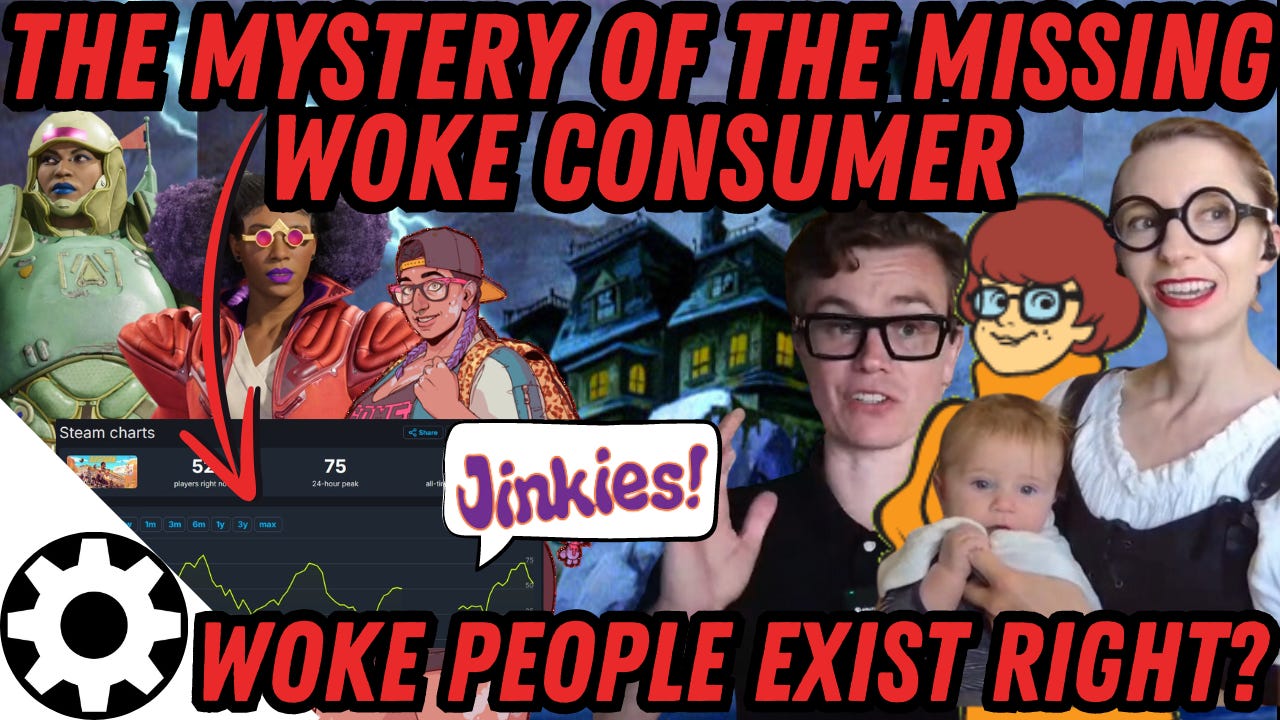
Why Are Woke People Not Buying Woke Products? ... Are Woke People Fictional?
In this podcast episode, the hosts delve into the catastrophic failures of recent 'woke' video games and explore the puzzling absence of a supportive woke audience. They discuss the severe underperformance of high-budget titles like 'Concord' and 'Dustborn,' theorizing why these games failed despite being heavily marketed to woke ideologies. The conversation expands to analyze the broader implications of wokeism in the culture, video game industry, and corporate environments. They also consider alternate theories about why woke signaling doesn't translate into tangible support and how this might signal a larger cultural shift.
[00:00:00] can we activate , a woke user base? If we just go pure woke, be creative, go story heavy. Like, is that something that can be done?
Right. Answer appears to be no. And so this is genuinely a little perplexing to me. Because my interpretation of the current American electorate or body is about 15 to 20 percent of America Genuinely hold some form of woke ideology.
Yet this faction is not buying anything. And the question is why now I there's, I'm going to go over the generic theories that people make, right? One is to say, well, the mistakes that these companies are making is that they are listening to people who are very loud online, which is predominantly people without anything else going on in their lives, i.
e. [00:01:00] unemployed people. Who don't have the money to go out and buy games. And it's like, that's an interesting theory. But the problem with that theory is I can just look at the donations from , the famed tech company. And like, 98 percent of , Facebook is going to The Democrats or I can look at the very fact that Sony even thought to produce this day.
Clearly, there's a large technocratic faction in America that works in large well paying bureaucracies that is Or at least signals that they are woke, right?
Would you like to know more?
Hello, Simone! It is wonderful to be here with you today! I am excited to be chatting with you, and the reason I am excited to be chatting with you today is Something happened in the video games industry, which is this last week, which is going to change American culture and world culture going forward.
That's a big statement. [00:02:00] The consecutive and catastrophic failure of one, a AAA title and then two, a really big and, and sort of emblematic woke game. And so in this podcast, I think many people have missed the core mystery of what's happening here. What they focus on is the wokies are trying to be like, Oh, you know, horrible right wing.
Boycott caused us to lose, blah blah blah blah, right? You know, that's their take on this. And then the right wing is looking at this and saying, Oh my god, this is amazing, look at them suffering, look at them seething, like, Things are gonna definitely have to change here. And I think what's being missed between these two interpretations, Is where is the woke audience and when I say this, I mean this in a real sense.
I'm not saying the woke audience is smaller than woke people expect it [00:03:00] to be, right? I'm saying it appears the woke audience. Is virtually non existent and where this is really made clear to me that was on a slide scholars episode right now and the other guest was a a former college professor and he was talking about all the woke stuff that was happening on his campus And I was like wait, wait, wait, we cannot be here gloating About how no woke people exist to buy these products while at the same time talking about this woke oppressive environment on college campuses.
Yeah. Right. Where is the woke customer? There's a discrepancy at play, right? So first I want to talk about why this is so big. Okay. So there have been video game crashes in the past, which permanently transformed the industry like. The E. T. game for people who are familiar with that. Actually, I want to quickly look up how many copies sold at that.
Yeah, but very famously, I think, what, in the late 80s, that was supposed to be one of [00:04:00] the early biggest investment video games ever. I think it maybe had record amounts of investment in its development. And it also obviously was associated with extremely successful IP in the form of the E. T. movie. The video game came out, massive flop, nobody wanted to play it.
And it goes down in video game history as a massive failure. This, apparently, was worse than that. Well, so, let's, let's, let's give an idea of how much worse than that it is, okay? Oh my gosh, okay. So the OOP D video game was developed by a single developer, okay, a single guy made the game, okay? Oh. It sold 2.
6 million copies. It flopped so hard, it destroyed the video game industry and forced it to remake itself. This is when the video game industry was in its infancy. Today, the video game industry makes more money than the TV and movie industries combined, in terms of cultural impact. [00:05:00] Yeah, the consumers are there.
So anything, even shitty things, should be making a decent amount of sales. Right. So, remember, 2. 3 million is what it had sold, right? 2. 3 million. Okay, so, Conker. This is a game that was a flagship title for Sony, alright? This was a game that had 100 to 200 million dollars in development, a large team working on it, and it was in development for over 8 years.
How can something cost that much money? Consider it like a movie budget or something like that.
So, Sony had so much faith in this game, they acquired the studio that was making it. They made controllers that were themed to go with the game. They made Sony devices. Like, what are those called again?
Playstations. Playstations themed to go with the game. So this game was released about a [00:06:00] week ago at this point. To great fanfare, apparently. To great non fanfare, yes, but yes. It, right now, concurrently on Steam, has 68 players. Huh! The game peaked at 697 concurrent players on Steam. Um, Oh my god! I, so to compare though, like, what's, what's a normal, like a, non, maybe we'll say a boutique game.
You know, made by an independent developer. How many concurrent players might they have on Steam?
Okay, what's a game that you've heard of that's what I can use a game from a while ago that I've heard of Skyrim Grand Theft Auto Dead Red Redemption because it's tough. I remember like a billion years ago
skyrim, concurrently, right now, has over 2, 000 people playing it, and it came out decades ago at this point. Red Dead Redemption 2 here 000 players right now. This came out like five years ago. 26, 000 players. Okay, how about the Harry Potter game [00:07:00] that everyone was like, let's cancel it, because that was an anti woke game. Yeah, okay. We'll see. Let's look for something that recently came out like these, because this is still going.
Yeah, except, well, why I like the Harry Potter one was because I know it's still on shelves, because we saw it this morning. And two it was supposed to be a game that people who were woke would not play for political reasons. Okay Harry Potter Just like people who were woke would play Concord for political reasons, theoretically. Okay, Hogwarts Legacy. So this game is at That looks fun. 13. 5 thousand right now. Okay. And like, back to Concord, how many concurrent players at its launch? At its absolute peak, it was at 697. Oh! Oh, lord almighty! Okay, now see, that has the impact I was looking for. Remember the other game I told you ET sold 2. 3 million copies of Rivermaster fluff?
Concord sold About 25, 000 copies across all [00:08:00] platforms. 25, 000. Wow. It's sold about the same number of copies as there are concurrent players of Hogwarts legacy today, even though Hogwarts legacy came out forever ago. Yes. Wow. That's a good comparison. Wow. But it wasn't the only instance of something like this happening recently to just, you
You May Also Like

The Latest with Loren LoRosa
The Black Effect Podcast Network and iHeartPodcasts

Daily Inspiration: The Steve Harvey Morning Show
Peter Mutua

RADIO KULTURAEUROPA
RADIO KULTURAEUROPA

How Men Think
iHeartPodcasts

During the Break with Clint Powell
Clint Powell

Keeping It Real: Conversations with Jillian Michaels
Jillian Michaels

The Fred Show On Demand
The Fred Show

Coach Corey Wayne
Coach Corey Wayne

CAMINANDO POR EL MEDIO
Radio Trend Topic

Am I the Jerk?
youtube.com/amithejerk
The Latest with Loren LoRosa
The Black Effect Podcast Network and iHeartPodcasts
Daily Inspiration: The Steve Harvey Morning Show
Peter Mutua
RADIO KULTURAEUROPA
RADIO KULTURAEUROPA
How Men Think
iHeartPodcasts
During the Break with Clint Powell
Clint Powell
Keeping It Real: Conversations with Jillian Michaels
Jillian Michaels
The Fred Show On Demand
The Fred Show
Coach Corey Wayne
Coach Corey Wayne
CAMINANDO POR EL MEDIO
Radio Trend Topic
Am I the Jerk?
youtube.com/amithejerk
Community discussion