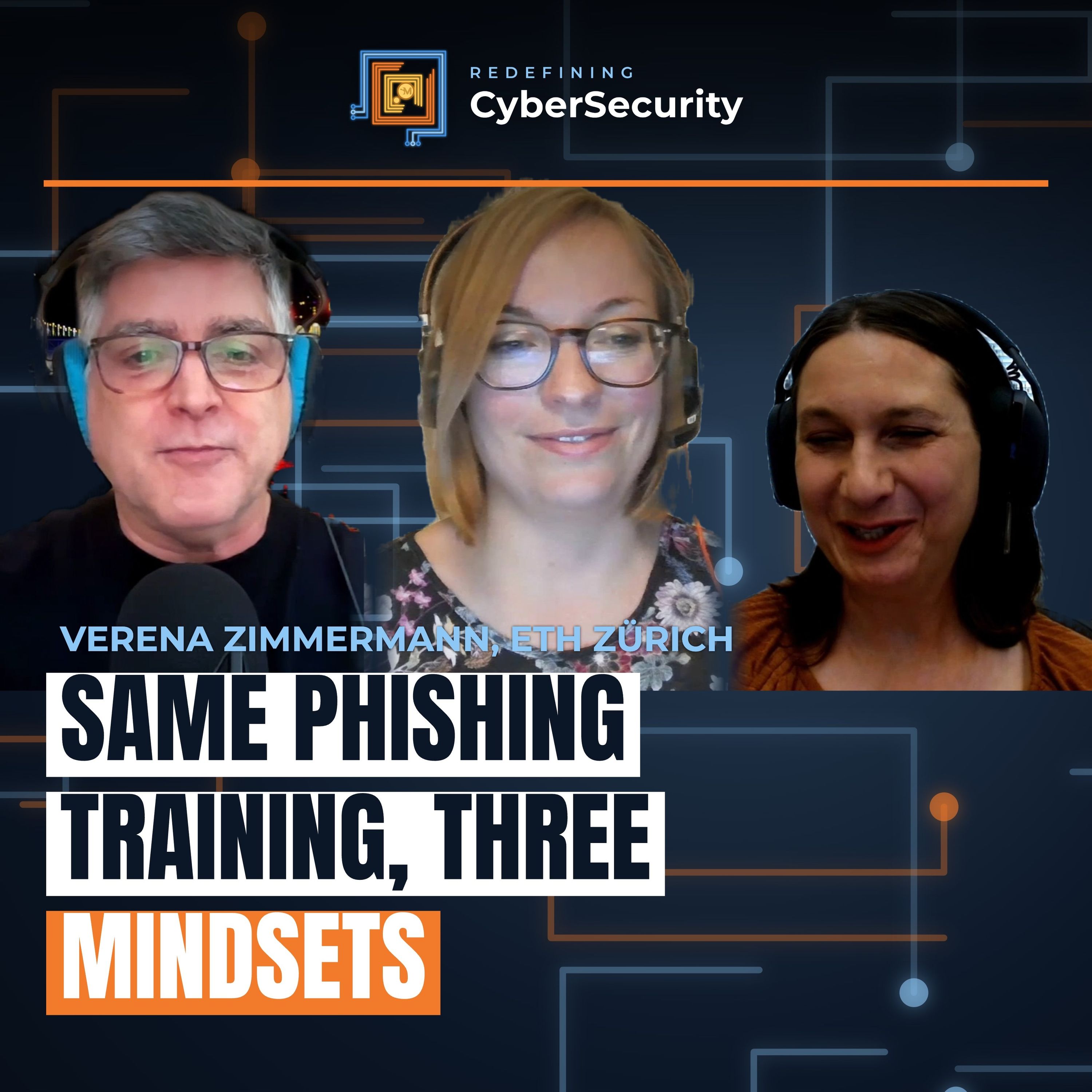
Phishing Training Looks the Same Under Three Mindsets | Human-Centered Cybersecurity Series with Co-Host Julie Haney and Guest Verena Zimmermann | Redefining CyberSecurity with Sean Martin
Show notes
Phishing training looks like one measure from the outside. Verena Zimmermann, Assistant Professor (Tenure Track) for Security, Privacy and Society at ETH Zürich, says it can be classified as a constraining, considering or enabling approach, and that "the intervention itself doesn't necessarily tell us a lot about the mindset that's behind it, and I think that's, that's crucial because that's the starting point." Zimmermann joins Sean Martin and co-host Julie Haney to discuss the article she co-authored, "Human-Centered Cybersecurity Revisited: From Enemies to Partners."
Zimmermann uses phishing to make the mindsets concrete. A constraining approach means automated attachment blocking, filters, a ban on private use of work email and compliance training. A considering approach starts with the human: gamified training so knowledge sticks, and warnings that are more salient and better understood. An enabling approach switches perspective and learns from users about their challenges, what they do right, what motivates them to report, and their ideas for jointly designing better ways to detect phishing, including from employees who detect phishing reliably and warn others. She also says constraining is not necessarily a bad approach, since an employee does not want to deal with 100 phishing emails every day, though a ban on private email use could create insecure situations where private and work life intersect.
The conversation then turns to credibility. Zimmermann says an organization that tells people they are partners, then ignores their ideas, gives no feedback on reported phishing emails, or publicly blames and shames someone who clicks, is communicating something that is not credible. Her advice is to be aware of the mindset you want and think it through from communication to action, and to listen to employees at every level, including developers and administrators.
Sean Martin adds that looking at how people think and act is not new to business, since marketing and product development do it, and urges security leaders to find where it has worked and apply it to their program.
For security and risk leaders, the question the episode raises is whether the program's actions match the word "partners" it uses with its own people.
Host
Sean Martin, Co-Founder at ITSPmagazine, Studio C60, and Host of Redefining CyberSecurity Podcast & Music Evolves Podcast | Website: https://www.seanmartin.com/
Co-Host
Julie Haney, Computer Scientist and Human-Centered Cybersecurity Program Lead at National Institute of Standards and Technology (NIST)
Guest(s)
Verena Zimmermann, Assistant Professor (Tenure Track) for
You May Also Like

The Data Chief
ThoughtSpot

The Good Tech Companies
HackerNoon

Security Weekly Podcast Network (Video)
Security Weekly Productions

Security Weekly Podcast Network (Audio)
Security Weekly Productions

Mac OS Ken
Ken Ray

Elon Musk Podcast
Stage Zero

TechCrunch Startup News
TechCrunch

Artificial Intelligence Masterclass
AI Masterclass

Emilcar Daily
Emilcar

Al otro lado del micrófono
Jorge Marín Nieto - Editor de podcast en EOVE Productora
The Data Chief
ThoughtSpot
The Good Tech Companies
HackerNoon
Security Weekly Podcast Network (Video)
Security Weekly Productions
Security Weekly Podcast Network (Audio)
Security Weekly Productions
Mac OS Ken
Ken Ray
Elon Musk Podcast
Stage Zero
TechCrunch Startup News
TechCrunch
Artificial Intelligence Masterclass
AI Masterclass
Emilcar Daily
Emilcar
Al otro lado del micrófono
Jorge Marín Nieto - Editor de podcast en EOVE Productora
Community discussion