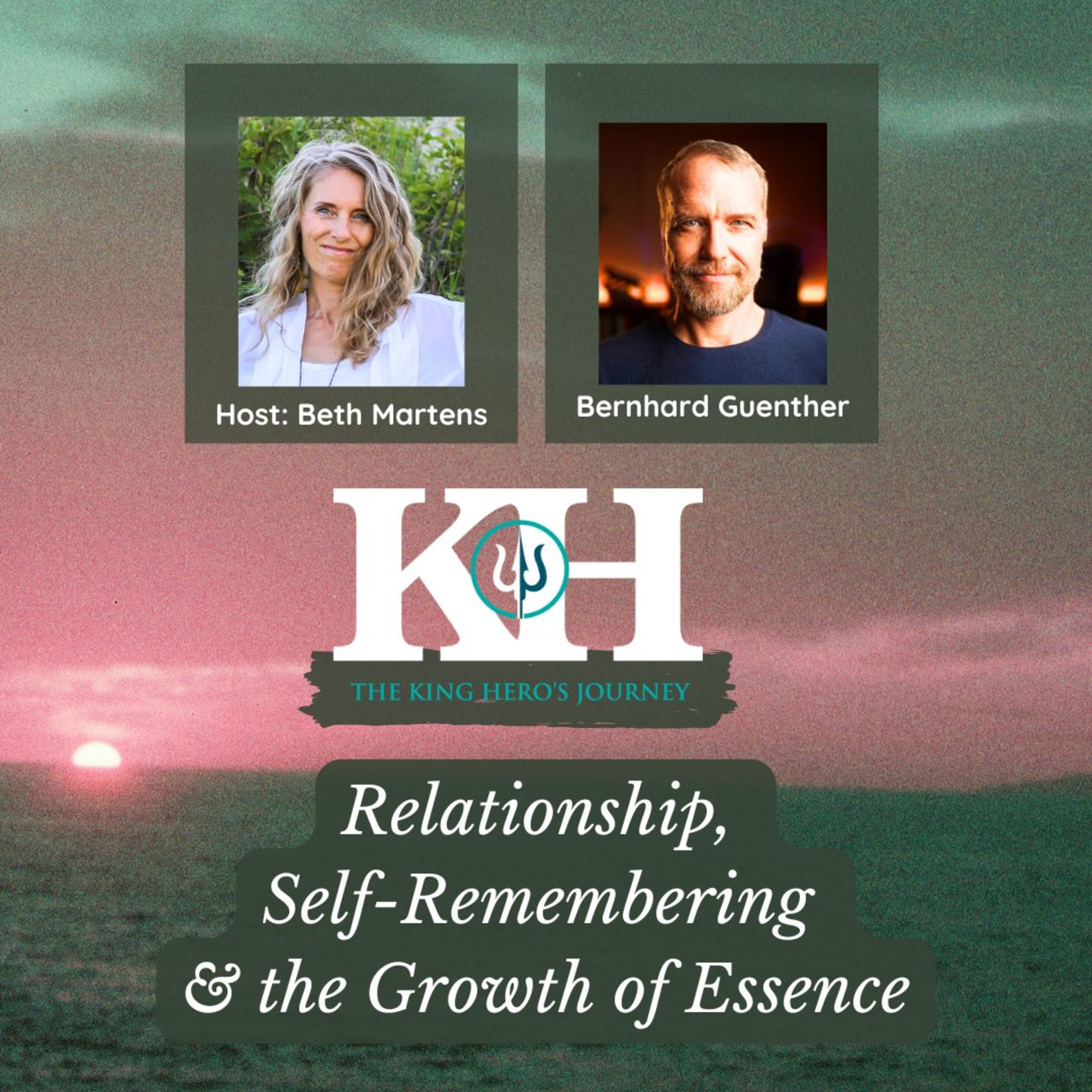
Bernhard Guenther: Relationship, Self-Remembering & the Growth of Essence [King Hero Interview]
In Part 1 of my conversation with Bernhard Guenther, we explored personal and planetary purification, Gurdjieff's cosmology, inner work, and the relationship between the state of the individual and the state of the world.
For Part 2, I want to bring the conversation closer to home:
What happens to our inner work when we actually have to live with other human beings?
Gurdjieff's Fourth Way was sometimes called "the way of the sly man" because it didn't require withdrawing from ordinary life into a monastery, an ashram, or a cave. Life itself becomes the field of practice.
Relationships. Family. Work. Conflict. Attraction. Irritation. Responsibility. Money. Sex. Community.
All of it provides material for self-observation and opportunities for self-remembering.
And relationship may provide something that solitary practice simply cannot.
Another person can reveal identifications, expectations, unconscious agreements, projections, defenses, demands, and mechanical reactions that might remain completely invisible when we're alone. Relationship creates friction, and with it, an opportunity to see ourselves.
So what can relationship reveal—or actually develop in us—that solitary spiritual practice cannot?
Bernhard has spent decades immersed in psycho-spiritual work, relationships, shadow integration, and the Fourth Way. In this conversation, I want to explore what he's actually observed in himself and others over that time.
What causes the growth of essence to accelerate?
What causes it to become stagnant?
And importantly, how do we distinguish the genuine growth of essence from the improvement of personality?
A person can become more articulate, knowledgeable, emotionally sophisticated, spiritually educated, socially skilled, or accomplished. But does any of that necessarily mean their essence has grown?
How would Bernhard actually recognize the development of essence in another human being—or in himself?
We'll also explore the difference between conscious relationships and relationships organized around unconscious agreements.
What are we actually agreeing to beneath the surface of our relationships? What happens when one person begins to change and can no longer participate in an old agreement? And what does relationship become when two people are willing to use what arises between them as material for seeing themselves more clearly?
I'm especially interested in the question of collective evolution.
We hear constantly about humanity "waking up," raising consciousness, shifting timelines, and entering new stages of evolution.
But what does any of that mean if the individual human being remains mechanically driven by unconscious patterns?
And conversely, what becomes possible collectively when individuals genuinely develop greater consciousness, presence, responsibility, and freedom?
Can humanity evolve collectively without the development of the individuals who compose it?
And could our relationships with one another be one of the primary places where that development is actually tested and made real?
That's where I want to take this conversation.
More about Bernhard Guenther at https://veilofreality.com
***
MORE FROM BETH at https://www.bethmartens.com
You May Also Like

Estas Rica
Sonoro | danisayan
Money Making Conversations Master Class
Rushion McDonald

Szélsőközép
Szélsőközép
Woman's Hour
BBC Radio 4

Mark Narrations - Reddit Stories
Mark B

Avec philosophie
France Culture

The Daily Horoscope
The Daily Horoscope
Thrilling Threads - Conspiracy Theories, Strange Phenomena, Unsolved Mysteries, etc!
Byte & Pieces

De Jortcast
NPO Luister / AVROTROS

The Ranch Podcast
Matt Todd
Estas Rica
Sonoro | danisayan
Money Making Conversations Master Class
Rushion McDonald
Szélsőközép
Szélsőközép
Woman's Hour
BBC Radio 4
Mark Narrations - Reddit Stories
Mark B
Avec philosophie
France Culture
The Daily Horoscope
The Daily Horoscope
Thrilling Threads - Conspiracy Theories, Strange Phenomena, Unsolved Mysteries, etc!
Byte & Pieces
De Jortcast
NPO Luister / AVROTROS
The Ranch Podcast
Matt Todd
Community discussion