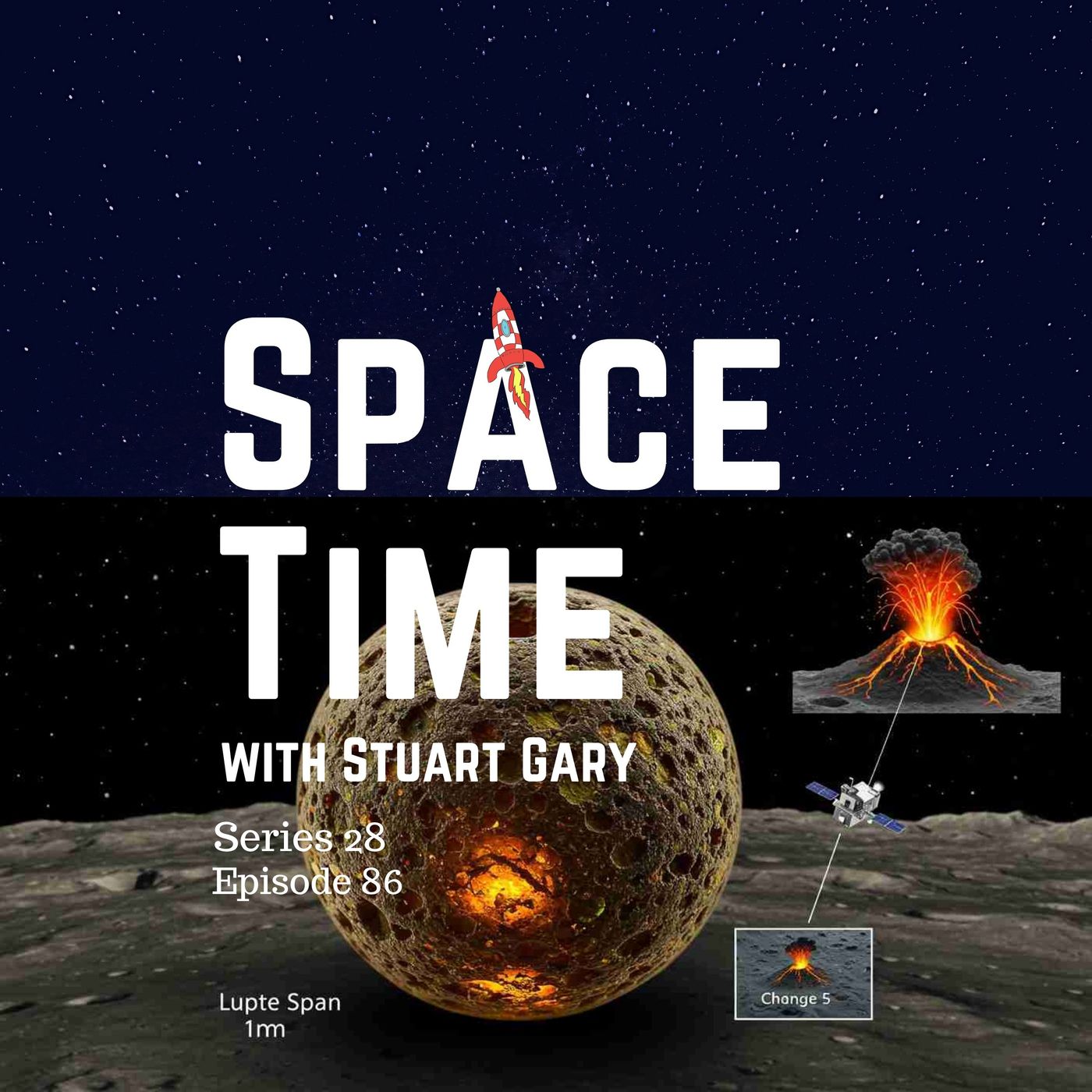
Dark Dwarfs and Lunar Insights: The Youngest Meteorite and New Discoveries in the Carina Nebula
In this episode of SpaceTime, we explore the latest discoveries in lunar geology, the intriguing concept of dark dwarves, and the stunning features of the Carina Nebula.
The Youngest Basaltic Lunar Meteorite
Scientists have uncovered a 2.35 billion-year-old lunar meteorite, Northwest Africa 16286, which fills a significant gap in our understanding of the Moon's volcanic history. This meteorite, distinct in its chemical profile, suggests that volcanic activity on the Moon persisted longer than previously thought, unveiling new insights into its internal heat generation processes. Lead author Joshua Snape from the University of Manchester explains how this rare sample enhances our knowledge of lunar geology without the costs associated with space missions.
Hypothetical Dark Dwarfs and Dark Matter
A new study proposes the existence of hypothetical objects called dark dwarves, which could help unravel the mystery of dark matter—an invisible substance that constitutes approximately 80% of the universe's mass. Researchers suggest that these low-mass objects could interact with dark matter in ways that produce observable effects, providing a potential pathway to understand this elusive component of the cosmos. The study highlights the importance of identifying markers, such as lithium-7, to confirm the existence of dark dwarfs and advance our understanding of dark matter.
Adaptive Optics and the Carina Nebula
Using adaptive optics, astronomers have achieved unprecedented clarity in imaging the western wall of the Carina Nebula, revealing intricate structures previously hidden by dust and gas. This breakthrough allows for a deeper investigation into star formation processes in this massive stellar nursery. The enhanced images showcase how massive young stars influence their surroundings and contribute to the cycle of stellar life, offering a glimpse into the conditions that may have shaped our own solar system.
www.spacetimewithstuartgary.com
✍️ Episode References
Journal of Cosmology and Astroparticle Physics
https://www.journalofcosmology.com/
Nature Journal
https://www.nature.com/nature
Become a supporter of this podcast: https://www.spreaker.com/podcast/spacetime-space-astronomy--2458531/support.
00:00 00:49 04:51 09:17 15:16 17:08
You May Also Like

HOLOSKY PODCAST
Holosky Podcast

The 365 Days of Astronomy
365DaysOfAstronomy.org

Farm Small Farm Smart Daily
The Modern Grower Podcast Network
Stuff To Blow Your Mind
iHeartPodcasts

One Planet Podcast · Climate Change, Politics, Sustainability, Environmental Solutions, Renewable Energy, Activism, Biodiver
Creative Process Original Series

The Biotech Startups Podcast
Excedr
The Best of Coast to Coast AM
iHeartPodcasts and Coast to Coast AM

BrainStuff
iHeartPodcasts

Unexplainable
Vox

Untold Radio Network
Untold Radio Network
HOLOSKY PODCAST
Holosky Podcast
The 365 Days of Astronomy
365DaysOfAstronomy.org
Farm Small Farm Smart Daily
The Modern Grower Podcast Network
Stuff To Blow Your Mind
iHeartPodcasts
One Planet Podcast · Climate Change, Politics, Sustainability, Environmental Solutions, Renewable Energy, Activism, Biodiver
Creative Process Original Series
The Biotech Startups Podcast
Excedr
The Best of Coast to Coast AM
iHeartPodcasts and Coast to Coast AM
BrainStuff
iHeartPodcasts
Unexplainable
Vox
Untold Radio Network
Untold Radio Network
Community discussion