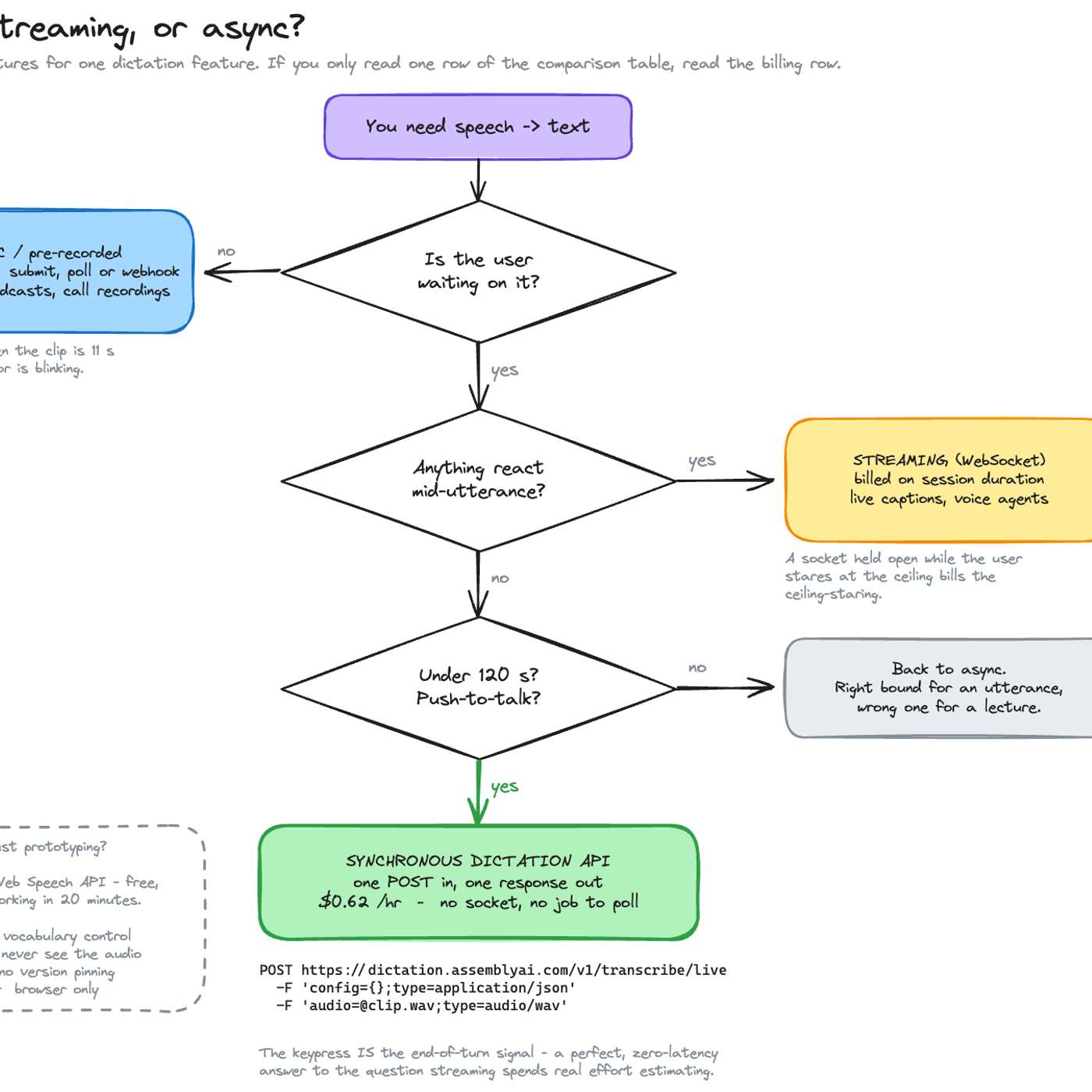
Designing a Low-Latency Speech-to-Text Pipeline for Dictation
This story was originally published on HackerNoon at: https://hackernoon.com/designing-a-low-latency-speech-to-text-pipeline-for-dictation.
Push-to-talk dictation doesn't need a WebSocket. Here's how streaming, async, and a sync dictation API compare on latency, billing, and failure modes.
Check more stories related to undefined at: https://hackernoon.com/c/undefined. You can also check exclusive content about #speech-to-text, #dictation-api, #assemblyai, #voice-interfaces, #streaming-transcription, #web-speech-api, #speech-recognition, #good-company, and more.
This story was written by: @assemblyai. Learn more about this writer by checking @assemblyai's about page, and for more stories, please visit hackernoon.com.
Dictation has different architectural requirements from live captions, voice agents, and long-form transcription. This article compares browser, streaming, asynchronous, and synchronous approaches, then explains why a synchronous request model can make sense for push-to-talk dictation, including the trade-offs around latency, retries, cleanup, customization, and cost.
You May Also Like

The Data Chief
ThoughtSpot

Security Weekly Podcast Network (Video)
Security Weekly Productions

Security Weekly Podcast Network (Audio)
Security Weekly Productions

Mac OS Ken
Ken Ray

Elon Musk Podcast
Stage Zero

TechCrunch Startup News
TechCrunch

Artificial Intelligence Masterclass
AI Masterclass

Emilcar Daily
Emilcar

ITSPmagazine
ITSPmagazine, Sean Martin, Marco Ciappelli
Al otro lado del micrófono
Jorge Marín Nieto - Editor de podcast en EOVE Productora
The Data Chief
ThoughtSpot
Security Weekly Podcast Network (Video)
Security Weekly Productions
Security Weekly Podcast Network (Audio)
Security Weekly Productions
Mac OS Ken
Ken Ray
Elon Musk Podcast
Stage Zero
TechCrunch Startup News
TechCrunch
Artificial Intelligence Masterclass
AI Masterclass
Emilcar Daily
Emilcar
ITSPmagazine
ITSPmagazine, Sean Martin, Marco Ciappelli
Al otro lado del micrófono
Jorge Marín Nieto - Editor de podcast en EOVE Productora
Community discussion