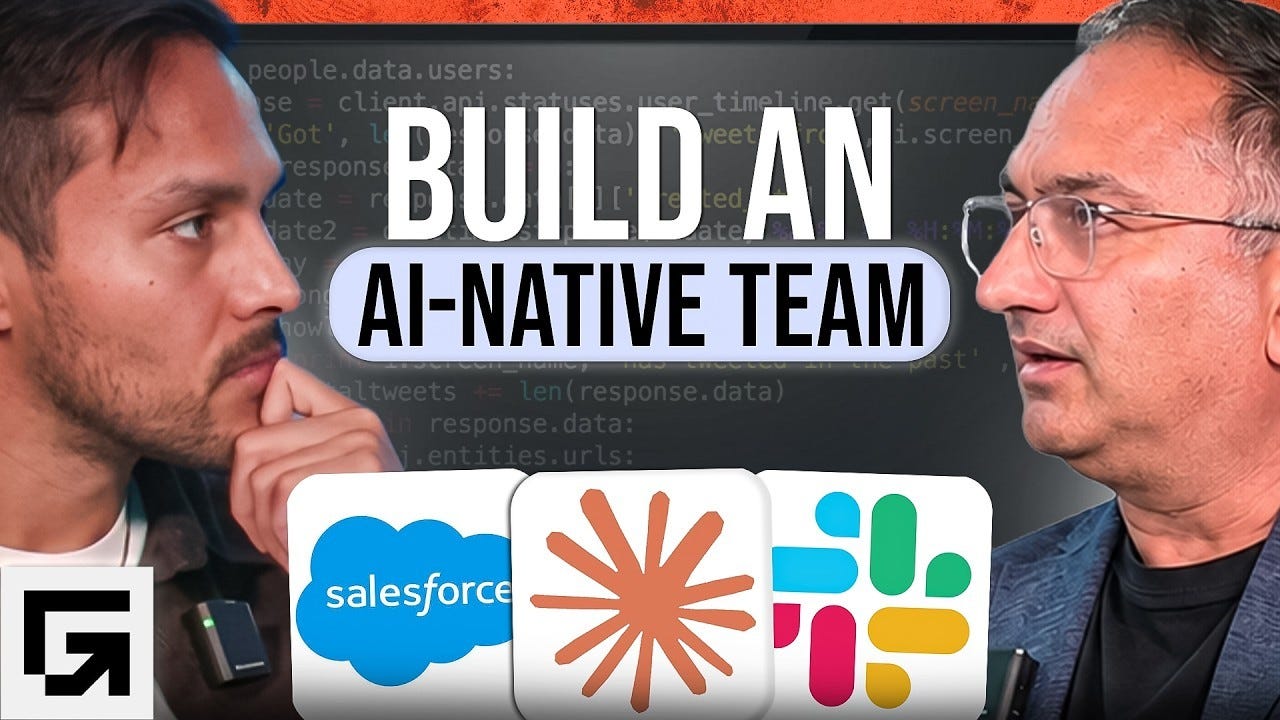
What an AI-Native Product Team Actually Looks Like at Salesforce
Brought to you by
Fingerprint: Identify good and bad visitors with industry-leading accuracy
Ariso: Ship AI agents and features faster, with fewer regressions
Customer.io: Send smarter messages using your product data
Land your next PM role: Coached live by PM leaders who've hired at Meta, Uber, Microsoft, etc
Product Faculty: Get $150 off their #1 AI PM Certification via code AAKASH150
Today's Episode
Salesforce and Anthropic announced Claudeforce in August. Now a sales team can ask Claude about its pipeline without ever opening Salesforce.
That worries me. LLMs are probabilistic, and you can't have two pipeline numbers.
So I sat down with Jayesh Govindarajan, who runs AI engineering at Salesforce. His teams build Agentforce, the foundation customers use to build their own agents. He walks me through how Salesforce gets one right answer out of an agent every time.
Then he lays out the ADLC, the life cycle that replaces the SDLC once your software is an agent.
If you're trying to turn your team AI native, this is the one episode to watch.
10 Key takeaways
1. Manage agents instead of doing the work - Jayesh says the biggest change in his org is mental. People stopped asking how to do the work by hand. They now ask how to manage a team of agents that does it.
2. Keep tool choice open - His engineers started on Cursor, then moved to Claude Code. Every tool clears security review first, then teams get a choice for a while. Real usage data tells leadership what to back next.
3. The value was never the UI - Going headless puts Salesforce's business logic behind an API. Customers pull decades of tuned workflows into Claude through skills and build whatever interface they want on top.
4. Let deterministic tools hold the ground truth - You describe an agent in plain English and it transpiles to Agent Script, which spells out the tool calls and context lookups. The model orchestrates tested APIs instead of writing fresh code. Hallucination drops sharply.
5. Go eval-first - Jayesh's data science teams were eval native from day one. Now his engineering teams are catching up with custom scorers tied to outcomes and built for each specific agent.
6. Make Slack the context layer - Slack is the one place people are available asynchronously all the time, and that history is gold dust for agents. A PM can mock up a prototype in a Slack thread with a customer and get feedback before a PRD exists.
7. The product trio lines are blurring - Engineers now put prototypes in front of customers directly. PMs no longer wait on engineering. Team ratios haven't shifted yet, but Jayesh already sees work bleeding across roles.
8. AI PMs need prototyping and evals - Jayesh calls these two skills the magic bullet. When he hires, he looks first for agency, then for craftsmanship that refuses AI slop and turns skepticism into failing test cases.
9. Adopt the ADLC - The agent development life cycle covers how you build, test, evaluate, deploy and observe an agent. The model underneath keeps changing, so without evals you are too afraid of breaking things to upgrade. Salesforce's new optimization agent watches every live agent for drift.
10. Start simple, then go wall to wall - Define value and an ROI metric before you build. Minimize variables on the first implementation and get one win. One of Europe's largest recruiting firms started with text agents in 17 languages and is now moving to voice.
Go Deeper
How to Build a Full AI Dev Team in Claude Code
A Company OS on Hermes and OpenClaw
AI PM Crash Course with Aman Khan
How Zapier's CEO Grades PMs on AI Fluency
Listen and watch on Apple, Spotify, and YouTube.
If you want to advertise, email productgrowthppp[at]gmail[dot]com.
To hear more, visit news.aakashg.com!
You May Also Like

Jak Piggott
Jak Piggott

Jack Hopkins
Jack Hopkins

Emilcar Daily
Emilcar
Bit-Rauschen: Der Prozessor-Podcast von c’t
c't Magazin
Al otro lado del micrófono
Jorge Marín Nieto - Editor de podcast en EOVE Productora

Artificial Intelligence Masterclass
AI Masterclass
AI Fire Daily
AIFire.co

Home Assistant Podcast
Mostly Automated Media
Joe Lonsdale: American Optimist
Joe Lonsdale
Upgrade
Relay
Jak Piggott
Jak Piggott
Jack Hopkins
Jack Hopkins
Emilcar Daily
Emilcar
Bit-Rauschen: Der Prozessor-Podcast von c’t
c't Magazin
Al otro lado del micrófono
Jorge Marín Nieto - Editor de podcast en EOVE Productora
Artificial Intelligence Masterclass
AI Masterclass
AI Fire Daily
AIFire.co
Home Assistant Podcast
Mostly Automated Media
Joe Lonsdale: American Optimist
Joe Lonsdale
Upgrade
Relay
Community discussion