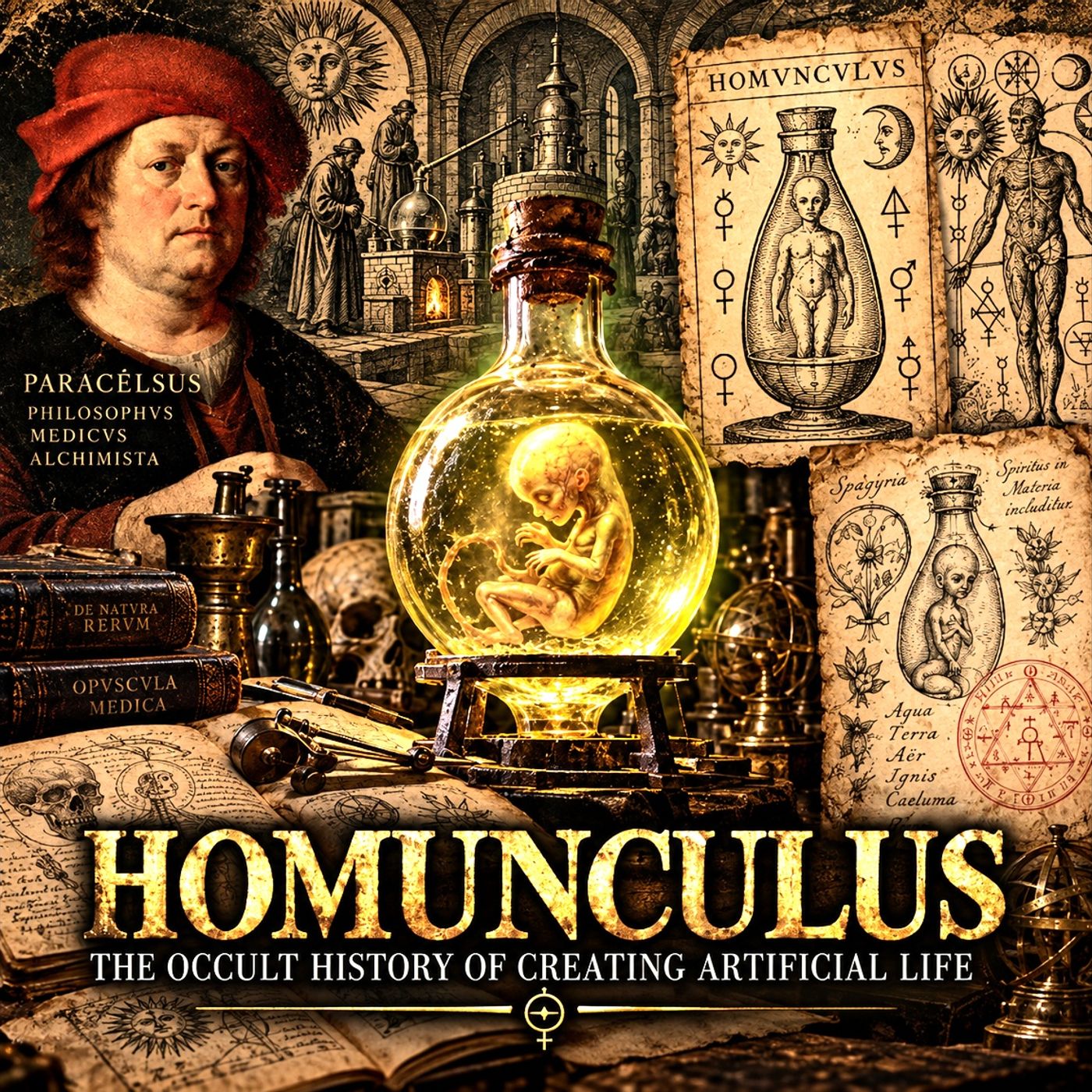
Homunculus: The Occult History of Creating Artificial Life
Links For The Occult Rejects
https://linktr.ee/theoccultrejects
Occult Research Institute
https://www.occultresearchinstitute.org/
Substack
https://substack.com/@theoccultrejects?r=7auau0&utm_campaign=profile&utm_medium=profile-page
Cash App
https://cash.app/$theoccultrejects
Venmo
@TheOccultRejects
Patreon
https://www.patreon.com/TheOccultRejects
Bibliography
PRIMARY AND HISTORICAL SOURCES
Apollonius Rhodius. Argonautica. Especially Book IV for the story of Talos.
Aristotle. Generation of Animals.
Aristotle. History of Animals. Relevant to ancient theories of reproduction and spontaneous generation.
Babylonian Talmud. Sanhedrin 65b. Rava's creation of an artificial man and the encounter with Rabbi Zeira.
Besetzny, Emil, ed. Die Sphinx: Freimaurerisches Taschenbuch. Vienna: Rosner, 1873. Especially “Die wahrsagenden Geister des Brs. Joh. Ferd. Grafen von Kueffstein,” beginning around p. 111. This is an important early printed source for the later story of Kueffstein's alleged “prophesying spirits” or homunculi.
Hartmann, Franz. The Life of Philippus Theophrastus Bombast of Hohenheim, Known by the Name of Paracelsus, and the Substance of His Teachings. London: George Redway, 1887. Hartmann reproduces the Kueffstein story while explicitly tracing it to Besetzny's 1873 Sphinx and alleged Masonic manuscripts and Kammerer's diary.
Hartsoeker, Nicolaas. Essay de dioptrique. Paris: Jean Anisson, 1694. Contains Hartsoeker's famous speculative depiction of a miniature preformed organism associated with spermist preformationism.
Homer. Iliad. Book XVIII. Relevant passages include Hephaestus's intelligent golden attendants and his self-moving tripods.
Ovid. Metamorphoses. Book X. Pygmalion and the animation of the manufactured human form.
Pseudo-Paracelsus / Paracelsian tradition. De natura rerum. Particularly the section traditionally cited for the generation of the homunculus. Modern scholarship makes the authorship and textual history substantially more complicated than older occult editions suggest.
Sefer Yetzirah / Book of Formation. Various recensions and translations. Foundational for later Jewish mystical traditions involving creation through letters, numbers, and divine language.
ALCHEMY, HOMUNCULI, AND ARTIFICIAL LIFE
Newman, William R. Promethean Ambitions: Alchemy and the Quest to Perfect Nature. University of Chicago Press, 2004. Particularly Chapter 4, “Artificial Life and the Homunculus.” This is one of the most important scholarly sources for the entire episode and for the larger medieval/early-modern debate over art versus nature.
Newman, William R. “The Homunculus and the Mandrake: Art Aiding Nature versus Art Faking Nature.” In Genesis Redux: Essays in the History and Philosophy of Artificial Life. University of Chicago Press, 2007. Especially useful for the relationship between the Paracelsian homunculus, mandrake/Alraun traditions, and artificial generation.
Newman, William R. “Bad Chemistry: Basilisks and Women in Paracelsus and pseudo-Paracelsus.” Ambix 67, no. 1 (2020): 30–46. DOI: 10.1080/00026980.2020.1720341.
Gantenbein, Urs Leo. “Real or Fake? New Light on the Paracelsian De natura rerum.” Ambix 67, no. 1 (2020): 4–29. DOI: 10.1080/00026980.2020.1720339. Essential for the disputed authorship, multiple-author evidence, and the 1571 earliest presently identified manuscript of De natura rerum.
Hirai, Hiro. “Into the Forger's Library: The Genesis of De natura rerum in Publication History.” Early Science and Medicine 24 (2019): 485–503. Important for the pseudo-Paracelsian publication context surrounding the text.
Murase, Amadeo. “The Homunculus and the Paracelsian Liber de imaginibus.” Ambix 67, no. 1 (2020): 47–61. DOI: 10.1080/00026980.2020.1720359. Useful for showing that the biological bottle-creature was not...
You May Also Like

Let the Bible Speak Radio
Dr. Alan Cairns

Satsang - Sant Shri Asharamji Bapu Satsang
Sant Shri Asharamji Bapu Ashram
Next Level Soul Podcast with Alex Ferrari
Alex Ferrari

Shine FM
Touch Canada

Quazi Johir
Quazi Johir

Brant & Sherri Oddcast
Brant Hansen

Manna: Daily Scripture Meditations
Reformed Perspective

The Bible For Busy People
Purposely

Dan Seaborn
Dan Seaborn
Light + Truth
Desiring God
Let the Bible Speak Radio
Dr. Alan Cairns
Satsang - Sant Shri Asharamji Bapu Satsang
Sant Shri Asharamji Bapu Ashram
Next Level Soul Podcast with Alex Ferrari
Alex Ferrari
Shine FM
Touch Canada
Quazi Johir
Quazi Johir
Brant & Sherri Oddcast
Brant Hansen
Manna: Daily Scripture Meditations
Reformed Perspective
The Bible For Busy People
Purposely
Dan Seaborn
Dan Seaborn
Light + Truth
Desiring God
Community discussion