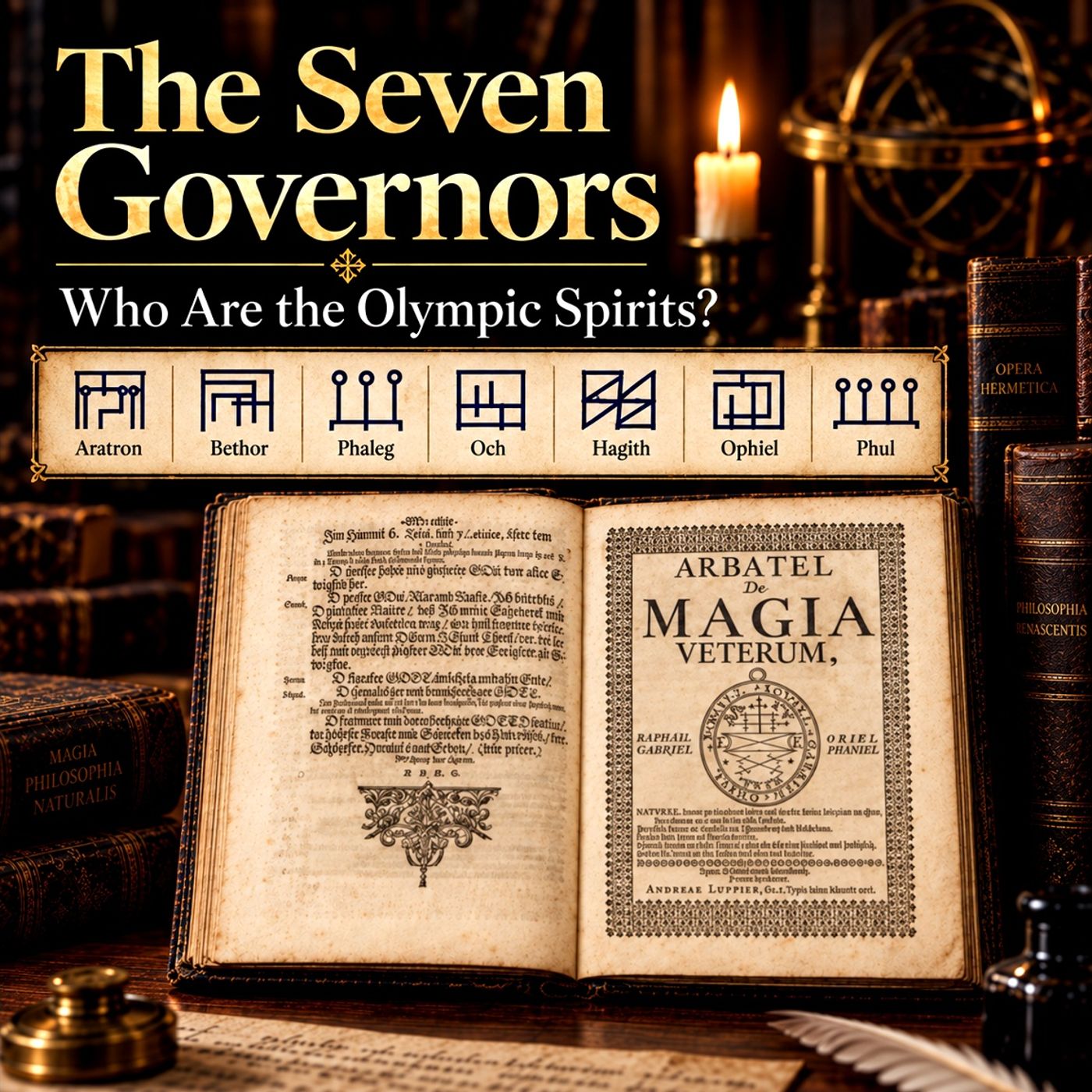
The Seven Governors: Who Are the Olympic Spirits?
Links For The Occult Rejects
https://linktr.ee/theoccultrejects
Occult Research Institute
https://www.occultresearchinstitute.org/
Substack
https://substack.com/@theoccultrejects?r=7auau0&utm_campaign=profile&utm_medium=profile-page
Cash App
https://cash.app/$theoccultrejects
Venmo
@TheOccultRejects
Patreon
https://www.patreon.com/TheOccultRejects
PRIMARY AND EARLY SOURCES
Anonymous. Arbatel de magia veterum: summum sapientiae studium**. Basel: [Peter Perna], 1575.**
This is the principal primary source for the episode and the earliest known printed appearance of Aratron, Bethor, Phaleg, Och, Hagith, Ophiel and Phul as the seven Olympic governors. The surviving 1575 copy held by the Universitätsbibliothek Basel is especially important because it allows comparison of the original Latin against later translations. The Basel catalogue identifies the edition as printed in Basel in 1575 and attributes the printing to Peter Perna.
Most heavily used: Aphorisms 14–21, particularly 15–18 for the definition of Olympic Spirits, their names and governments, planetary provinces, characters, the 490-year periods, “Olympic speech,” and the warning concerning the temporary efficacy of spirit names.
Turner, Robert, trans. “Arbatel of Magick.” In Henry Cornelius Agrippa, His Fourth Book of Occult Philosophy; Of Geomancy; Magical Elements of Peter de Abano; Astronomical Geomancy; The Nature of Spirits; Arbatel of Magick**. London: J.C. for John Harrison, 1655.**
Turner’s translation became one of the principal routes through which English-speaking occultists encountered the Arbatel. It is also important for tracing later translation problems—particularly Turner’s rendering of the duration of efficacious Olympic names as forty years rather than the 140 given in the Latin. The Library of Congress preserves and digitizes the 1655 volume.
Trithemius, Johannes. De Septem Secundeis, id est, Intelligentiis sive Spiritibus Orbes post Deum Moventibus**. Written 1508; first printed 1522/early sixteenth-century editions.**
Essential for the planetary-governor system preceding the Arbatel. Trithemius describes seven secondary intelligences governing the world beneath God for periods of 354 years and four months. His Saturnian governor Orifiel is explicitly described as bearing a “name of office, not of nature” — nomen est officii, non naturae, an extraordinary conceptual parallel to the Arbatel’s later emphasis upon office over permanent names.
Pietro d’Abano [Peter of Abano]. Conciliator differentiarum philosophorum et praecipue medicorum**. Early fourteenth century.**
Important for the earlier planetary-spirit tradition underlying Trithemius. The planetary names associated with this current include Cassiel, Sachiel, Samael, Michael, Anael, Raphael and Gabriel. Peterson’s research traces Trithemius’s planetary-age doctrine back through this material.
Paracelsus [Theophrastus von Hohenheim]. De causis morborum invisibilium [On the Causes of Invisible Diseases]. Written c. 1531–1532; first printed posthumously in the sixteenth century.
One of our most important pre-Arbatel sources. Paracelsus uses Olympic Spirit / Olympic Spirits in connection with invisible celestial operations and the relationship between the stars of the macrocosm and those within the human microcosm. Peterson identifies this as a key source for understanding the Arbatel’s Paracelsian vocabulary.
Paracelsus. Philosophia Sagax**. Written c. 1537; first printed 1571.**
Particularly important because Paracelsus projected a third book concerning Olympici Novi. That portion is not preserved as part of the authentic work. Its absence has led scholars—including Joseph Peterson—to consider whether the Arbatel’s Olympic material emerged partly within the intellectual space created by Paracelsian ideas about Olympic magic. This should remain presented as a...
You May Also Like

Let the Bible Speak Radio
Dr. Alan Cairns

Satsang - Sant Shri Asharamji Bapu Satsang
Sant Shri Asharamji Bapu Ashram

Quazi Johir
Quazi Johir

TRUNEWS with Rick Wiles
Morning Manna with Rick Wiles

Next Level Soul Podcast with Alex Ferrari
Alex Ferrari

The Light
Touch Canada

Shine FM
Touch Canada

Brant & Sherri Oddcast
Brant Hansen

Manna: Daily Scripture Meditations
Reformed Perspective

The Bible For Busy People
Purposely
Let the Bible Speak Radio
Dr. Alan Cairns
Satsang - Sant Shri Asharamji Bapu Satsang
Sant Shri Asharamji Bapu Ashram
Quazi Johir
Quazi Johir
TRUNEWS with Rick Wiles
Morning Manna with Rick Wiles
Next Level Soul Podcast with Alex Ferrari
Alex Ferrari
The Light
Touch Canada
Shine FM
Touch Canada
Brant & Sherri Oddcast
Brant Hansen
Manna: Daily Scripture Meditations
Reformed Perspective
The Bible For Busy People
Purposely
Community discussion